Enjoy a brand new cognitiveSEO Talks – On Search and Traffic with Dawn Anderson, an all-in-one professional that will make you take out a pen and a sheet and note everything she has to say.
There’s a lot to say about Dawn. She is a skillful digital marketer and SEO consultant with over 11 years of experience, Lecturer at Manchester University. She is also a speaker and trainer, contributing in international conferences and she also founded Move It Marketing Agency back in 2012.
As Dawn herself mentioned in the talk above, SEO is about constantly digging and looking for secrets. And talking about secrets, let me tell you something about Dawn; although she seems that she’s been doing SEO& digital marketing since forever, Dawn had a previous career in a totally different domain: she managed a building maintenance company. Maybe one of the greatest things about the search industry is that people come from very diverse backgrounds.
There are so many SEO elements you need to keep an eye on, so many ranking factors; we can never guess exactly what they are and this is why every year we end up with more Google ranking factors to consider.
DAWN Anderson
International SEO consultant & Digital Marketing Lecturer @dawnieando / Move It
Aside from being a great SEO consultant, the director of Move it Marketing is also a big dog lover. And if you listen to the interview carefully, you’ll be hearing her cute pomeranian joining the conversation.
We could list dozens of reasons why one should listen to this cognitiveSEO talk episode with Dawn. Yet, we wouldn’t want to spoil you the joy of discovering an engaging conversation sprinkled with insights and words of wisdom.
The key is always to try to make great sites and to develop your technical skills as much as you possibly can.
DAWN Anderson
International SEO consultant & Digital Marketing Lecturer @dawnieando / Move It
Tackled Topics:
How Dawn got into SEO and search marketing
The importance of testing in SEO
Duplicate content issues for eCommerce sites
Crawl budget and how it impacts a site
Best use cases for PPC and SEO
The impact of voice search in SEO
The Google mobile speed update and its impact
Top 10 Marketing Nuggets:
Make sure you have some small test sites of your own even if you’re brand new in the industry. 2:06
The key is to try to make great sites and to develop your technical skills as much as you possibly can. 10:02
Internal links are for me often as powerful as external links. 11:35
Crawl budget on massive sites can impact rankings. 11:50
Technical issues are like a slow painful death by a thousand cuts on a big website. 14:26
[For e-commerce websites] Add photos, reviews, videos, linking content, xml sitemaps as it’s another way of enhancing your overall website with another layer of data Google does have access to. 23:34
We don’t know if links are being ignored by search engines. It’s a play in the dark. 29:45
Voice Search will massively affect SEO. Maybe not today but in the next couple of years, we’re going to see that. 31:01
No one person in this industry has all the answers. Be critical, read widely, test widely; make sure to try learning all the time. 36:12
If you have slow loading sites you should be looking to address it; one of the biggest thing that you can do is to optimize images.41:39
We all keep hearing that any publicity is good publicity. But is it really so? And, more importantly, is it the same for SEO? We’ve all heard about the link building technique using unlinked Brand Mentions It’s a good method and, as far as we know, it works very well.
But what if the unlinked brand mention that you’re so excited about turns out to be a RipoffReport post? What if it’s a blogger complaining about your services, or a news publisher reporting on some incident regarding your brand?
Should you also get a link from this kind of sources as well? Will it help you or will it harm your website’s rankings? Well, you’re about to find out!
In this article we will dissect how Google treats this matter and find out if negative brand mentions impact your rankings and SEO efforts. So, keep reading.
1. How Web Brand Mentions Affect SEO Today
In general, we all know that a good branding and PR will positively affect our business. It makes sense. People love well established brands with a lot of satisfied customers and great deals.
For example, most people would still buy an iPhone over a Xiaomi Phone, although some models apparently have similar characteristics and lower prices. People buy from certain brands because of trust and authority. To obtain the audience’s trust, a brand must be well established and have good PR.
For your business to flourish online, besides earning the customers’ and audiences’ trust, you also have to win the search engine’s trust.
Customer and search engine trust kind of go hand in hand, but, from what we know, SEO works based on some algorithms. There are many important factors which lead to authority, from domain age and security to backlinks, CTR and branded searches. We’ll ignore domain age, as it’s not really something we have control over, but we’ll be focusing on the other ones.
1.1 Brand Anchor Text Backlinks
As presented in this link building lessons article, websites with a high percentage of branded anchor text backlinks tend to rank higher than the ones with a high percentage of commercial anchor text backlinks.
Screenshot from the cognitiveSEO Tool showing anchor text distribution for a top ranking website in its niche
The cause for this phenomenon is probably Google’s association of these links with naturalness. When talking about you on the web, people are more inclined to link to your website through a branded or URL anchor text, rather than through a commercial anchor text.
1.2 Unlinked Brand Mentions or Google Implied Links
A website can also have a high number of unlinked brand mentions across the web. They are often called citations and are very popular within the local SEO field.
While these probably don’t provide as much value for SEO as backlinks do, they certainly have an impact. Google actually has a patent on that so we know it’s true. It defines them as implied links:
Screenshot from Google’s patent defining implied links
The key element here is relevancy. The citations you’re getting to your local business should reflect the location of your business. If you’re in Seattle but get citations from Russian websites that mostly mention Russian businesses using Cyrillic characters, don’t expect your rankings to grow very fast.
On the other side, if your business targets a global market, then it makes sense to have all sorts of unlinked mentions across different countries. Relevant content is also important, so don’t spam on every site.
Also, keep in mind that mentions that do contain backlinks, especially dofollow ones, have a lot more impact on your search engines than mentions that don’t.
How unlinked mentions compare to linked mentions.
That’s a chainmail armor. Get it? … couse … it has links? (ba dum tsss)
So, generally speaking, Google does take a look at your unlinked brand mentions and the content surrounding those mentions, but it’s better if you can get a link back to your website from them. That way you can be sure that you maximize the potential of the mention, as it’s both a mention and a link at the same time.
And remember, you want to get mentions from reputable websites that are relevant to your niche and geographic targeting, be them linked or unlinked. Creating them yourself using the same IP might turn out to be a waste of time and could actually get you into some trouble.
A great way of finding your unlinked mentions is Brand Mentions, a web mention monitoring tool. It has a lot of advanced features, but this is one of the best, as it enables you to establish a connection with webmasters that mention you and potentially acquire a link.
Screenshot from the Brand Mentions tool showcasing the potential to discover unlinked web mentions
1.3 Branded Search Queries
We can categorize search queries into two types: branded and non-branded. A non-branded search query would be “keyword tool” and a branded search query would be “cognitiveSEO keyword tool”.
You want to be ranked on both of them. If you’re not ranking for your own brand name, that is kind of bad. You either chose the wrong brand name, or you’re heavily penalized by search engines.
Each of the two has a catch:
Non-branded keywords, for example, have a high search volume, which means a lot of potential customers. However, there’s a lot of competition there, so they are harder to rank for and the CTR might be lower.
Branded Keywords, on the other side, have probably a low search volume, but they are very easy to rank for (if you are that brand) and the conversion rates are very high, as usually the users already know what they want.
Although this is speculative, some experiments and observations (including some of our own) have shown that branded keywords can eventually increase the rankings for non-branded keywords. So, if a lot of people search for “your brand + keyword” and click on your website, you should also see an increase in rankings on the “keyword” itself.
Rand Fishkin also agrees on this and explains it in his following video of the Whiteboard Friday:
These being said, it’s always a great idea to work on your PR so that people search for your brand on the web and associate products with your brand. Not only will it increase conversion rates, but it can also help with rankings on non-branded keyword versions.
2. How Does Google Treat Negative Brand Mentions
Ok, so we know that Google likes branded anchor text links and looks at brand mentions across the web to establish your website’s authority.
But, in real life, having more mentions isn’t necessarily better. What if you have thousands of negative reviews, mentions related to fraud or other bad stuff? That could affect you business deeply, or even send it into bankruptcy.
2.1 Google’s Search Quality Evaluator Guidelines
Google’s algorithms can’t yet determine what is good and what is bad. That’s why the company has set up a team of humans (around 10,000 or so) to take care of the job. The initiative doesn’t only target brand mentions. The purpose of these evaluators is to help improve the quality of the search results in general.
Unlike the manual spam team, which can apply manual actions on websites, the search quality evaluators can’t directly influence search rankings. Instead, they follow these guidelines to evaluate websites and provide feedback about the search results to Google.
From the guidelines, we can observe that Google demands the lowest rating to be given to websites with negative or malicious reputation.
One criteria would be harmful pages that contain malware or that are phishing for information (page 37), but we can also see on page 43 that the evaluators should consider low BBB ratings and other sources that expose fraudulent behavior.
Screenshot from the Search Quality Guidelines
We can also include the issue of Fake News. Fake News websites purposely create these fake stories as shocking as possible, not to influence people necessarily, but to gain hype on social media, which brings traffic to their websites which eventually makes them money from ads.
These fake stories can ultimately even rank high in Google for specific keywords. Fake News have a big impact on Political Campaigns, as messages spread through Fake News often influence the decisions of uninformed and naive voters.
You can watch the following video for reference about why fake news are so popular:
So far, it’s a known fact that social media hype, backlinks and a lot of mentions can get you ranking at the top. Unless the story is critically dangerous, such as one that incites to violence, it can rank there for a very long time without any manual action being taken.
Google also has an initiative in which they will work closely with journalists to combat fake news. The search quality evaluators also play an important role, as they can provide patterns that fake news websites use, which can help the algorithm raise a red flag much easier.
However, the subject is a lot more sensitive. Malaysia, for example, has passed a law against fake news which could be punished with over $100,000 in fines and up to 6 years of jail time. This raises questions about free speech and corruption (in that particular case). Same thing goes with Google, as they would literally have to censor some websites if they consider them to be fake news websites by not giving them a chance to rank for certain keywords.
2.2 How The Google Algorithm Works
After the evaluators provide their feedback and Google compiles the info, it gets fed to the algorithm. This way, over time, Google starts understanding the patterns of fake news or malicious websites and websites with a very bad reputation.
It’s hard to tell what exactly the algorithm will be based on, but I can speculate looking for reviews in structured data or similar implementations, articles related to fraud or other criminal activities and even news sites or videos. It can then follow patterns, affecting an entire server or network of similar sites related in any way with the initial penalized low quality/reputation website.
One thing’s for sure: Google’s algorithms will be constantly improving and will eventually be able to understand if a business has a very bad reputation or if it’s involved in any suspicious or criminal activities.
3. Will Negative Brand Mentions Affect Your Google Rankings?
If we’re only talking about a small part of your customers leaving negative reviews or a couple of bloggers trashing you for not accepting their promotion offer, there’s nothing to worry about. In fact, it might actually benefit you if you can get backlinks.
However, if we’re talking about massive PR drops, thousands of complaints, serious fraud and the press going crazy over it, then yes, it probably will. But not in the way you might think it will. To be more exact, it won’t directly impact your rankings, but they will ultimately drop because of other indirect factors.
3.1 Is All Publicity Good Publicity?
If you know about the White Moose Cafe, then you probably know about all the scandals regarding the vegans and the bloggers. If not, here’s some input:
So there are actually two stories. One is about some vegan complaining about the restaurant having no vegan food in it. The vegan community started blasting the Hotel’s (yes it’s actually a Hotel not a Cafe) Facebook page with 1 star reviews. The hotel then started mocking the vegan community.
This created a lot of hype with more vegans turning red and massively hitting the 1 star review button but, on the other side, there were a lot of people defending the White Moose Cafe.
More recently, a similar story took place after a YouTube content creator asked for free accommodation in exchange for exposure on her channel. The Hotel’s owner mocked her and the bloggers community started rolling in with 1 star reviews. The owners now posted about banning all bloggers from their hotel, just as with vegans, above.
Again, a lot of people were defending the White Moose Cafe and, after all this hype, the hotel’s Facebook Page still stands at 4.4 out of 5 stars.
The White Moose Cafe kept pumping their jokes by sending the blogger a bill for publicity services, topping over $6 million. While it might sound exaggerated, it’s actually pretty accurate. Considering the amount of hype the posts got around social media and how many news publications caught up on the story, the price seems fair. The blogger actually gained a fair 10,000-20,000 subscribers and most of her complaint videos were monetized.
Paul, the owner of the White Moose Cafe, actually has a great post about this in which he elaborates upon the topic and explains how controversy can be a great way of promoting your business, as long as you don’t get trashed completely (what if it was all actually a setup and they actually worked together?). The secret is to also have one side defending your point of view. Another thing you can do is simply ask questions instead of expressing an opinion.
While I don’t actually agree with trolling and insulting other people for publicity, I have to admit that I find it kind of funny at the same time, being both a vegan and a blogger myself. Paul has some strong points of view and reading through his blog you can actually see that he’s not a bad person.
Now these aren’t really negative brand mentions, as overall, the hotel seems to have gained more than it lost. But there are some that might actually get you into trouble.
3.2 Handling Negative Mentions From a Search Point of View
When users search the web, they often look for reviews. If it’s a product, they look for other people who have previously bought and used it. If it’s a service, they look upon other client’s experiences.
Reviews have a big impact on the purchase decision of a client, as the following survey shows:
Now some people are aware that not all negative reviews are accurate, but there are some review sites that are very trustworthy or, better said, credible. One of them, for example is RipoffReport, which lists scams, usually in the digital marketing field. People can comment on them, so usually there’s a community of people complaining instead of just an individual.
I had this user interested if they can make a RipoffReport post mocking one of his clients rank lower, as it was occupying one of the first 5 positions on their main brand search.
Screenshot from Intercom showing discussion. I censored the user’s name, photo and website for protection.
I told him that the only thing he can do is get the post removed somehow, although I knew he didn’t have any chances. I can’t show off the Google results as I’d probably have to black out 99% of the image, but you have my word, that RipoffReport is ranking high for their brand name and, considering the things said in that post, it doesn’t look very good for the company.
If you’re in a similar situation or your overall number of reviews is under 3 stars, then you should consider taking serious action on the quality of your products / services. Sometimes it might not be entirely your fault. For example, people might be complaining about slow shipping. But if it is so, then change the shipping company you work with.
People really care about reviews and if they avoid your website because of this, it kind of resembles a bad user experience, which we know Google cares a lot about and could potentially affect your rankings.
If this also results in a lower number of branded searches for your website, then it might also have a negative impact on your rankings.
3.3 Handling Negative Mentions From a Backlinks Point of View
As long as the link isn’t coming from malicious websites with malware or a very spammy link profile, I can’t really see how they could directly affect your rankings.
So far, we don’t have any data on links surrounding negative mentions, but we do know that links from malicious or spammy websites are bad.
The only way they could affect you is that users from the article that speaks badly about you might be able to land on your website, resulting into more negative reviews.
3.4 The Role of Artificial Intelligence
Eventually, we will reach a point where Google will become true AI. At that point, whatever the search quality evaluators have done so far, Google will be able to do it itself, probably an infinite times better. Fake news will be a thing of the past and the bot might even be able to distinguish between true fake news or hate speech and offenses and jokes.
Image Source: popsci.com
We’re not quite there yet, but it’s definitely something that Google’s trying to achieve. At that point, we’ll probably also reach the singularity and Google will have already found a solution to world hunger and all human problems so we won’t have to worry about SEO anymore.
4. How to Deal With Negative Brand Mentions
Well, the best way of dealing with them is not having them…
No, seriously, if your company is convicted for some sort of crime, you probably have bigger problems on your head. That’s not going to be easy to erase and even if you rebrand yourself, through the power of social media and social justice warriors you can’t stay undercover for long.
While you should constantly improve your customer care sector, there are some natural negative reviews and brand mentions that you can’t avoid with 100% accuracy. People are more likely to leave a review after a negative experience than they are after a positive one, so you’re already at a disadvantage.
The best way of dealing with negative reviews is to answer them, deal with them, learn from them and improve your services.
Sometimes, people are jerks. They rate your product or service 1 star for no real reason. For example, I’ve seen people just saying “It’s a bad product” without specifying why and others leaving a 1 star reviews because it didn’t match their expectations, comparing a low end product with a high end one, even though it was a good value for the price.
However, by explaining your point of view in the comments you have the opportunity to get your side of the story listened to. For example, I’ve recently read a comment in which one client was complaining about the CPU not matching his socket and that he sent it back but the store wouldn’t accept the return. The store replied and said that the CPU’s pins were damaged and that they even tried to repair it themselves but didn’t succeed.
By addressing the issues in the negative reviews, not only can you turn a customer’s frown into a smile but you can also show the other clients that you care, that you are sorry for what happened and that you are willing to learn and improve.
4.1 How do you find Your Negative Mentions
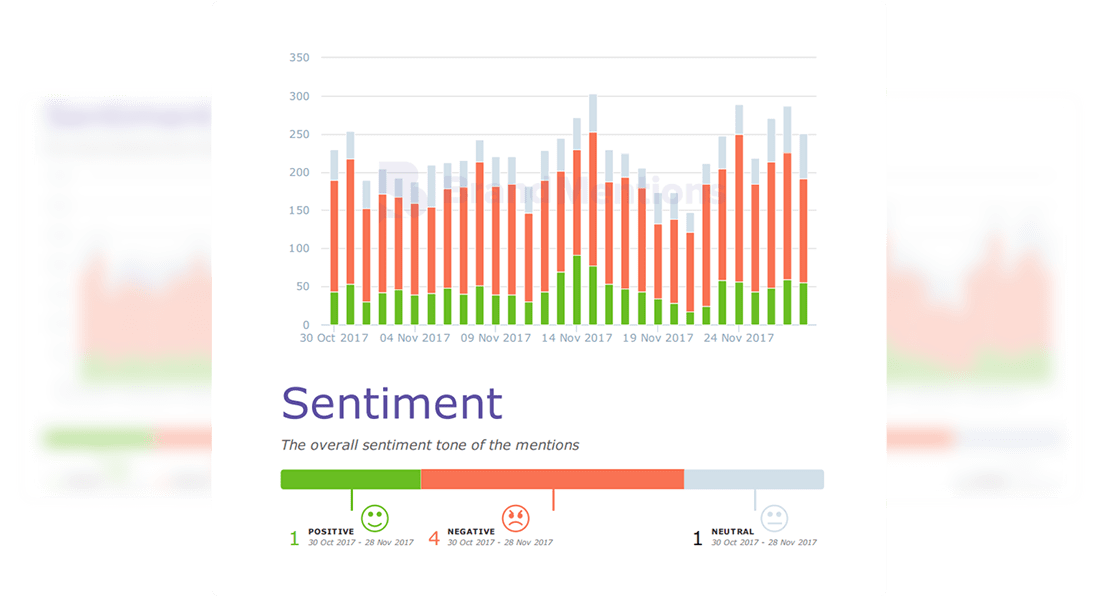
It’s hard dealing with negative brand mentions if you can’t track them, don’t you think? Well, Brand Mentions actually has a great feature that can sort out the good from the bad and make your life a lot easier.
Reputation management from Brand Mentions
So, if you want to manage your reputation you can always use the sentiment analysis feature, segment your mentions and deal with them a lot better.
Conclusion
So, in the end, it seems like negative brand mentions don’t directly impact your search engine rankings. However, if these mentions result in lower branded searches, or if other news sites rank above you on branded queries, then you might eventually suffer some SEO consequences as well
Have you ever experienced bad PR or negative brand mentions? If yes, did it affect your rankings? Did you manage to fix the issue? If yes, how? If not, maybe we can discuss it and find a solution. Feel free to start a discussion in the comments section below.
Since the last Penguin 4.0 (Real-time) update, lots of things have changed in terms of quality backlinks. Bad backlinks have remained the same, though, even if they were created some time ago with no intent to harm a website, or there was an arranged negative SEO attack or maybe a spammy link building campaign, with the purpose to rank high & fast. We’ve tackled this matter before, yet, we felt the need of updating this topic for 2018.
Toxic links have a higher effect on a website now than they ever had before. They can eat your whole website alive and stick it down, in the last pages of SERP. How, you might ask? Well, Google Penalites caused by unnatural links coming from:
To be prepared for the long ride and have a clean website, you should know that it requires two easy steps for a correct backlinks assessment. First, identify toxic backlinks and then remove bad backlinks. Some of the most known types of low-quality links are presented below. We thought on them through a guide to help you easily identify the unnatural links (link networks and low-quality links) that, maybe, caused the drop in your rankings. After that, you are served with tips and recommendations to clean your website of those links.
The SEO world has evolved so much in the past few years, which means the quality guidelines have become more strict. Links started to become somehow a problem, because of the amount of spam on the web. After reading this post, you will be able to identify low-quality links that hurt your rankings.
How to Remove Bad Backlinks
The steps for a clean website are simple. First, you need to identify the most damaging referring domains that are linking to your website, following the black hat linksfiltering explained below, and then remove and disavow the unnatural links.
Here are 4 steps to remove bad backlinks for your website:
Identify your bad links (you’ll find how exactly from this article).
Search for the contact information of the website you have the link on.
Contact the webmaster asking him to remove the link. If you don’t get a response in within 2 weeks, go to the next step.
Disavow the links and upload the file to Google.
Disavowing all the bad links doesn’t have to be a chore. In cognitiveSEO you have to use the Unnatural Detection which it is a helpful buddy. It will save you tons of time, energy and money. Below you can see a screenshot from the tool.
You have to click on the unnatural link bar chart and a new window will all the spammy links will pop-up instantly:
You have to select the links that are bad and disavow them. Either you do that individually or perform bulk actions. All those disavowed links will be gathered in a file-format agreed by Google, which you can download and send it from the tool directly to Google.
The disavowing process applies to all category of links explained below.
1. Link Networks
Over 90% of the Link Networks are easy to spot, both by the human eye and by the Google algorithm.
Most Link Networks have the following common patterns:
Architected from blogs and forums, because they are easy to automate and replicate.
Links try to look as natural as possible by being put inside the content of a blog post or forum thread.
The owner of a link network rarely makes the effort to generate links back to each of the generated blog posts. This means that each and every post has a probability of having 0 or a small number of backlinks pointing to them.
Each site from the link network links out to at least 2 common money sites.
To find the links coming to your website from link networks you need to filter down the backlinks by blog posts and forum thread links, that are positioned in content and have a low metric (link influence, domain influence) and a low number of incoming links to the actual backlink. The hardest part is to filter large lists of links by the tag in Content and type of link (blog post, forum page etc). You can either do it by hand or use a tool that has the ability to make these classifications.
Health Plan to Quickly Identify Backlinks Coming from Link Networks
By using cognitiveSEO, and applying a couple of filters, you can easily find those links exactly.
Order descending by Link influence to see the lowest quality pages first. Browse a bit through the links and use the link preview feature to quickly preview those pages. In our case we found 316 low-quality links coming from different pages on various link networks. (17% of their entire backlink profile)
To remove bad links, such as link networks, you should know something first.
Any of the following types of links can be both natural or artificial. The difference is how they were acquired in terms of link velocity and link distribution over the entire backlink profile of a site.
To identify if your backlink profile is unnatural, you should always compare your site to your competitors’ and check for major discrepancies between the backlink profiles of those sites. I usually compare my site with the top 5 leaders in the industry and then compare my site with 5 other sites that are trying to break into the niche. There are always things that come up when doing such an in-depth analysis.
You should compare metric distributions, such as link and/or domain influence, link and/or domain trust flow, link and/or domain citation flow. These are only the basic comparisons that you can make. The more advanced ones are when you start to compare links classified by webpage type, link type, in content versus not in content links, link position and so on.
2. Footer Links
Footer links were totally legit 6 years ago, but they started to make a lot of mess because of websites who abused of this technique.
That’s one of the reasons why Google placed site-wide links into the link schemes list. Those links can distort your analysis and do not present any value from an SEO point of view. Imagine if you have one link from one domain compared with 100 links from the same domain. First of all, the value of that single-domain-link is higher than each individual link coming from the same domain.
There was a question on the same issue on the Google Webmaster help forum:
Are sitewide backlinks considered good or bad by Google? Or do they just count as 1 link from the whole domain?
From an algorithmic point of view, at some point, it becomes asymptotically diminishing returns. And it doesn’t help you anymore.
Matt Cutts
Former head of the webspam team at Google
If they see a link form a domain they will count it as one, and if they see multiple links from the same domain, they might still count them as one.
From the manual point of view, you will receive a penalty, because Google doesn’t trust those links and performs manual actions quite often.
In case you have a high number of footer links, you will definitely raise a red flag to Google. Usually, footer links are acquired from sites that:
sell links;
are involved in link exchange schemes;
have widgets or plugins installed (usually for SERP manipulation);
“powered by” links ( ex: WordPress);
partners of your business;
clients that link back to you.
If you find only a few links compared to your entire backlink profile then there is no real problem here. If instead, you get a long list of links, you might have a problem.
There are situations when Google missed to flag footer links. One example is for Godaddy, where they have almost 90% of their links coming from footer links. We checked their site with the cognitiveSEO tool after they were exposed by Yoast explaining the GoDaddy’s spammy link building techniques. Every website created using a WordPress editor through GoDaddy has a footer text with a link such as “Powered by Do Daddy”. The thing is that they are still following this practice, but now you have the option to remove that text by yourself.
Health Plan to Quickly Identify Footer Links
cognitiveSEO.com allows you to select all the links that appear in blocks of links in the footer of the linking pages. For this site, we extracted 625 low-quality footer links (10% of their entire backlink profile).
There are options when you can easily spot the links that came from footer sections or groups of links. In the cognitiveSEO tool, you have a deep-link analysis where you can spot the inconsistency. Take, for example, the screenshot below:
On the site used for this example (www.addictinggames.com) we saw they had lots of links coming from Blog Posts or Forum Threads, which might not be bad (depending on the intent). But the alarming situation starts when you look at the number of links coming from groups of links: 8,024, which is a lot.
All those links must be reviewed individually and disavowed quickly otherwise, I hear the penalization alarm.
After a quick research in Site Explorer, we saw that the site suffered a massive drop in rankings because they were penalized. Since then, they haven’t been able to regain their search visibility.
3. Blogrolls & Other Blocks of Links
Blogrolls were abused so much, that they tend to be very carefully analyzed by the Google algorithm nowadays.
This category includes both blogroll links and groups of links that do not fit into the blogroll pattern. Here is an example of a website that used to abuse the search engines and is not a blogroll. The domain uses widgets that are installed on various websites where webmasters get to place their link. Too many links that fit these patterns might be viewed as unnatural by the Google algorithm and you might get penalized for them. Some of those links can fall into the sitewide link category.
Make sure you don’t have advanced link widget networks listed as site-wides, as they might get flagged faster. Like all of the other types of links presented in this guide, it all comes down to how they were integrated into your link profile.
Health Plan to Quickly Identify Blogroll and Groups of Links
A couple of filters away, you will get another list of low-quality backlinks that might hurt your rankings. In our case, we got other 424 low-quality links.
We analyzed that specific backlink in Site Explorer to see some metrics. We discovered that the page and domain had low influence carrying lots of links (47,365) coming from only 45 referring domains. That is a clear sign of unnatural links.
The problem was the website had lots of other unnatural issues and their backlinks profile was filled with spammy links. 88% of their whole links are unnatural.
If you find yourself in a similar situation, all the unnatural links must be disavowed and then you should immediately submit the disavow file to Google to cut the connection with that spammy links that can dreadfully bury your website.
4. Site-Wide Links
Site-wide links will definitely hurt your rankings.
Site-wide links are another example of toxic backlinks. They are old news on the Google landscape. Site-wides are devalued and can hurt your rankings so easy. If your domain does not have the necessary authority and receives a couple of site-wides from some low-quality sites, your site will get penalized by Google.
The idea behind the site-wide links is quite simple. It is more important to have more root domains link to your domain than to have many links coming from fewer root domains that link to your domain.
There are site-wide links that will not hurt your rankings, and it all depends on the site the site-wide is put on. If that site is considered an authority and that site-wide link is not correlated with other factors such as high link velocity, then that site-wide could help you.
Health Plan to Quickly Identify Site-Wide Links
Luckily, it’s quite easy to discover these type of links with cognitiveSEO as it’s a Sitewide Chart, dedicated to this matter.
You will get a chart with the distribution of sitewide links. If it is a high number, click on the pie and check those links individually. In our case, we got 21% of the whole backlink profile coming from sitewide links.
The website has lots of sitewide links that carry almost no value. Below you can see an example of a backlink for that website:
There are multiple problems with this link. Besides the fact it is sitewide, it is also hidden, written in white font. I had to highlight it to see the full text.
Note: A site-wide link is considered to be a link that is automatically replicated across a large number of pages from the same site. Do not missclassify a site-wide as 10 different links coming from 10 different articles on Techcrunch for example. Those are not considered site-wides. Our software has a built-in algorithm that matches different patterns and concludes whether a link is a TRUE SITE-WIDE or not.
5. Blog Comments
Blog comment spam evolved on the back of the search engines.
Comment spam is a form of spamdexing (keyword stuffing) and it has been around since the beginning of the internet. There are several tools that help the spammers post comments automatically with the final aim to reach higher rankings in the search engines. That is why most of the comments are marked as nofollow by the blogging platforms so that Google will not index them. Even so, spam commenting is a huge phenomenon and everyone that owns a blog knows how much comment spam they receive.
Health Plan to Quickly Identify Blog Comment Links
You can easily find both nofollow and dofollow links that are coming from blog comments.
For a quick review of the whole list of links that come from blog comments, you can go straight to the Link Positioning chart and click on the Blog Comment bar. We found a website that focused on building links through this technique:
We looked through their links and found out the website took advantage of this black-hat technique and left spammy blog comments on websites that weren’t even related to their website. Not to mention it used an anchor text that has a spammy appearance, considering the circumstances. The website is a free library of e-books and resources and the website they’re linking to is about website development. Not quite related, I might add.
6. Forum Profile Links & Signatures
Forums are abused the same way blogs are.
Having people discuss around your site in forums is the most natural thing that can happen to a site. It means your site generated some buzz in its niche. But, if you are doing link building using fake forum profiles, signatures and posting content and links automatically on forums, this will appear in your backlink profile and could hurt your ranking when Google will flag it. These kinds of patterns can be easily identified by Google. Below is an example of an unnatural link that comes from a forum.
Health Plan to Quickly Identify Forum Links
Again, cognitiveSEO makes it easy to identify links coming from forum threads. If you want to check signatures and profiles, you should search for Link Position » Short Paragraph of Text, Group of Links. You’ll get a list of links as you can see in the next screenshot.
In our example, you can find a preview page with some link info. The link has no influence and nor does the domain.
In case you want a quick analysis, you go straight to the Link Positioning chart and review the links from the Blog Post or Forum Thread. The website we analyzed had a lot of links coming from this source. 15% of the whole backlink profile is coming from blog posts or forum threads.
7. Web Directory Links
Forget Web Directory submission services that promise hundreds of directory registrations.
Having too many links coming from web directories is not always a good sign. This might raise a flag to the Google algorithm. You do not need hundreds of directories to be listed on, only a few quality ones that are well known in your niche. If you have a high percentage of links coming from directory submissions (manually or automatically), that were created some time ago or are freshly added (it doesn’t matter), you will raise the link velocity flag, and get penalized.
An example of a web directory links you can see in the next screenshot. Basically, it is a list with a short description of brands, with a title and a link.
Health Plan to Quickly Identify Web Directory Links
If you get a long list and it represents a big percentage of your inbound link profile (similar to the next screenshot), then this might signal a problem that you need to investigate even further. cognitiveSEO monitors backlinks and evaluates the unnaturalness for the whole website by offering percentages for the unnatural links, suspect links and ok links, letting you know if you are in danger.
In case your website has lots of unnatural links and red areas (like the one above) you should use the disavow tool and cut the connection to your website from all the spammy links.
Out of curiosity we looked through the unnatural links and found lots and lots of links that came from spammy directories, filled with hundreds of outbound links, just like the one below. There you could see that the page had lots of other issues, such as low influence link, thin content, a high number of outbound links and so on. You should remove the link immediately.
8. Article Directory Links
Avoid cheap content!
This is the best advice you could get. Having too many links from article directories is a sign that something unnatural is going on. Article directories and the sites they linked the most, were already hit by Panda in the last few years. Below is one way to find your article directory links so that you can further investigate them.
Article directories, if not created following qualitative guidelines, can be potentially harmful.
Health Plan to Quickly Identify Article Directory Links
Below you can see a print screen for the article directory links identify with our tool. We got 49% unnatural link profile out of their total unnatural links (23,594). Their total unnatural link profile is 87%.
The website received multiple hits from Google algorithm updates. This was easy to spot in their search visibility. In the last 5 years, they were hit by lots of penalizations from Google.
In cases like these, it is very important to disavow all the spammy links in bulk and clean the website. In 2018, a website shouldn’t have such toxic links. Try to monitor your backlinks to never find yourself in this situation.
9. Anchor Text Distribution
Over optimized anchor text does not look natural at all!
Anchor text is either:
brand keywords (domain name keywords or the actual brand name);
money keywords;
navigational keywords (click here, website, source and so on).
In cognitiveSEO you can easily classify and review your anchor texts. You’ll get an analysis as you can see below. A natural distribution of anchor text would look like this.
An artificial anchor text distribution looks like this:
If your anchor text is over optimized, you are likely to be hit by Google because most of the times commercial anchor texts carry unnatural links. Consider a natural anchor text strategy, collaborate with other brands and influencers. Create valuable content and offer qualitative services to get recommendations and good links.
Conclusion
I hope all the SEO tips and the step by step guide will help you identify the potentially toxic links that generated problems with the Google penalties. Use the cognitiveSEO tool to investigate your link data and get a comprehensive link audit. The tool shows all the data in one place, and monitors backlinks side by side with your competition.
Don’t build links that can harm your website, even if they used to work. Now, they don’t anymore.
Use these tactics to identify bad links and remove them before Google takes action and penalizes your site. The sad part is that black hat is bad for everyone, and it is hurting the internet. Be good, create quality and Google will love you.
Social Media Strategy is a guide to marketing, advertising, and branding in a world of social media-empowered consumers. Keith Quesenberry introduces readers to the steps of building a complete social media plan.
The inside scoop on 5 content distribution planning secrets you need for improved results. Includes step-by-step guide in the form of questions to lead you.
One of the first things that beginner SEOs get in contact with is link building, often far before they even hear about content quality or even basic things like proper keyword research or title optimization.
Link building is the most controversial topic in SEO and I believe that we should encourage people on not focusing too much on links alone . And in years of doing link building campaigns, I’ve learned a thing or two. So here they are: 12 lessons I’ve learned from dozens of link building campaign I’ve been working on.
If you’re an experienced SEO, you’re probably not very impressed about this first point. But there’s a big reason why it’s first in this list. I’ll ask you a question:
When you first started building links, what was the very first thing you tried?
If you’re an honest man, you’ll probably say that some sort of blackhat link building.
As I said, new SEOs often learn about link building first, far before they hear about anything else. Don’t believe me? Well, with all the (often contradicting) information overload on the internet, people turn to forums to get answers cleared out, because they can read the opinions of a dozen different people at once, or even ask questions directly themselves. Just take a look at one example from a forum:
Now you might be saying “Yes, but that’s a BlackHat SEO forum. I know it.” Well, that’s true, but take a look at how he says he’s new to SEO and has $600 to spend, yet he already knows about tools and link buying.
So it’s pretty clear that this beginner already knows something about SEO, just not the right stuff. Why? Because BlackHat SEO looks appealing. You apparently get quick results for very little work. Coming up with cool content ideas is hard and time consuming. Writing them even harder.
In reality, BlackHat SEO tools are expensive and have a huge learning curve. You’re better off building something solid and safe from the start.
How am I so sure? Well, because I’ve been there. I wanted to make my life easy. I purchased ScrapeBox, GSA Search Engine Ranker, Captcha Breaker and other software, in an attempt to easy my job.
I spent weeks if not months to learn the software, time in which I had other expenses that I wasn’t aware of at first, such as proxies. In the end, I realized that most links the tools were building were crap ones, because most websites didn’t only had captchas (which Captcha Breaker could occasionally pass) but were also moderator approved.
The results? Not impressive. Low to medium results with pretty much a lot of money, effort and stress put in. By low to medium results I mean not on page 1.
All this happened because I missed one key point. The user. I was so caught in my link building that I completely ignored other things. If I did any OnPage SEO, I constantly thought of ways to include more keywords on a page without looking TOO obvious, but never actually thought about the end user for a bit.
And I haven’t even mentioned penalties yet. I haven’t really experienced penalties personally (yet again I didn’t quite stick with blackhat methods for long) but many of our cognitiveSEO users and clients that I personally consult know very well the dangers of blackhat link building.
The real results started kicking in when I finally thought about how to make my website and content genuinely useful for the users. Sure, there are a lot of advanced tactics, technical optimizations and marketing schemes you can perform, but at the core, user experience is king.
There are also ISP (Internet Service Providers) issues. If you start spamming the web, they will eventually phone you to ask you if everything’s alright. You’ll have to lie, obviously, because it’s against their ToS and probably even illegal in some places.
A Black Hat Link Building Story
I interviewed a guy once and he told me about how he used to make around $1000 – $2000 per month by spamming the web. That sounds good, but he ended up with very little profit.
At first, he was only spamming with one computer and a dozen of proxies, averaging about $75 to $100 per month. So he then thought “Hey, why don’t I scale this up?”. Well… scaling up was a big investment. He ended up buying around 20 computers and also spent a lot of money on the energy bill and the internet service package. The total spending was close to $10000.
In about 3-4 months, Google started catching up with his scheme and penalized his websites. He started everything allover again, trying to stay under the radar, but each time, Google caught him. It took less and less for Google to catch up. At first 2-3 months, then 1-2 months until he abandoned everything.
With only 2-3 moths of full earnings, he ended up banking less than he spend on the whole setup. He could of course profit by selling the setup, which is a lot more time consuming than purchasing it. In the end, he ended up having nothing solid and realized it isn’t worth it.
2. Building Free Links Manually Takes Ages & Comes With a Lot of Disappointment
Clients ask about links almost all the time. “They heard that it helps with rankings, so they want as many as possible.” People usually ask for SEO consultancy offers and how many links per month they contain. it seems that in order to have an “SEO package”offer, you need to have some links there.
However, coming back to reality, it just isn’t possible to promise someone a number of links per month, unless you have a predefined set of website you link out from, which makes everything less relevant and more risky.
Not only that but you also put everyone at risk, because similar link patterns attract more attention and can impact the whole network. This means that if Google hits one site for link spam, it might hit every site with a similar link pattern. This is also the case with buying links, not only with building them. BlackHat tactics affect everyone, not only the performer.
I’ve been able to outrank and pull out my middle finger to websites that had dozens of very expensive links purchased and probably PBNs, all with almost no link building at all. I also did manual ‘link building’ here and there, but we’ll talk about it later in the article. I’ll explain why I’ve put link building between brackets, so keep reading.
To be honest, building links manually is just like using a BlackHat link building tool, but 100000 times slower and infinitely more frustrating, because there’s no filter for the failure (like the software), which now goes directly into your soul.
You, doing manual link building.
A friend of mine was recently assigned to build some manual links at his work place. After about one week, he sent me this message: “I feel like I’m doing this for nothing.”
3. Bought Links and PBNs are Too Expensive & Too risky
After finding out that manual link building literally makes you cry blood, I decided to purchase some links.
Here and there, you could get an occasional $10 per link, on a random worthless blogspot. For the real links, on news websites, for example, we were talking about $400 to $1000 per link. Many would also ask for monthly payments of $50 to $200 to keep a link online.
Of course, these prices apply to the markets I am familiar with; in other niches, links are probably a lot more expensive.
PBNs can probably be more efficient, however the risks are high and you also need to spend a lot of time creating them and making sure Google won’t catch them.
A Private Blog Network’s primary cost is content, which you could be very well creating on your main site.
Here’s a glimpse of how much it would cost you to build a PBN if you want to avoid doing the work yourself. Although these guys probably know what they’re doing, the risks are still there.
As long as you have multiple quality websites that you take care of, I don’t see the problem with interlinking them. However, you have to take into account the fact that Google might see it as a PBN and penalize it. I’d focus on one website first and when it really goes good and competition is already behind, I’d expand with another one.
It’s just that… sometimes, dofollow links ‘for SEO’ are more expensive than a regular advertising post on a high authority, high traffic, well established website. I consider the latter to be more effective. If you find a great advertorial opportunity/deal to get your product or website featured, then by all means go for it. But it’s a better idea if the link has a nofollow tag and if the promotion is clearly specified in the article.
4. Forum Posts & Blog Commenting ARE Useful for SEO
Wait! Isn’t this a BlackHat Tactic? I know, this might sound counter intuitive. But the answer si no, it isn’t a BlackHat tactic.
Forums are communities in which people share opinions, ideas and they are also a great resource. Blog comments are the way readers and content creators interact with each other.
In order to get links, you need to build connections. If you build connections then you’re doing forum posting and blog commenting the right way. Connections help you get more link opportunities. You get to know one webmaster, then they introduce you to another and so on.
But that’s not the only way to build connections. You can also go to meetings. Meetings and events are probably the most efficient marketing strategy you can spend time on. You can build more connections, land more leads and secure more clients in one single event ore meeting than you can in months of online efforts.
Sometimes, it’s not easy to find an event in your niche, but there definitely are adjacent niches where you can go. You just have to think outside the box. Alcohol brands, for example, promote a lot on music festivals. If you make shoes, you don’t have to find a shoemaker meeting. Just go to a fashion meetup, or maybe sports one, depending on your products.
Me (on the right) networking at an E-commerce Summit 2018
You might often meet bloggers in similar or adjacent niches and you can collaborate with them. You can also connect with them online, on their blogs. Chances of you getting your comments approved now are much higher. Most of the forum and blog comment links are nofollow anyway, but that’s not a problem, because nofollow links actually help you rank better. I have proof, keep reading.
If you have a small/medium website or a blog, don’t dismiss comments and forum posts completely.
5. Nofollow Links DO Help You Rank Better
We all want dofollow links. Not just for SEO, but even for our own sake. A nofollow sounds sort of like mentioning someone, but talking badly of him. In reality, nofollow links aren’t bad. They can still help you rank better. If you want proof, check out this article about nofollow links.
Countless times has it been proven to me that nofollow links help you rank higher.
If you do purchase an advertorial with a link, not only will you theoretically be legal by using a nofollow link, but you’ll tell Google “Hey, I’m following the rules. Are we cool?”.
Try it and you’ll see for yourself. Just don’t bother building useless nofollow links from spam or random posts on random blogs and forums. Use proper advertising on relevant websites with good traffic and adequate audience. That’s the best way to go for.
It’s funny, I’ve even found another “X link building mistakes” article which states that building nofollow links is in fact a mistake. A mistake is having an unnatural link profile and a 100% dofollow link profile is definitely unnatural.
The problem with dofollow links is that Google wants them to come naturally, without any monetary incentives. So Google decided to create the nofollow tag to be added to sponsored links. Obviously, nobody cared about that and Google had to bring in penalties.
So everytime you buy dofollow links, you’re exposing yourself to the risk of penalty. Google penalizes sites both ways, so publishers started avoiding giving dofollow links altogether.
John Mueller confirmed that adding a nofollow tag to any kind of paid or incentivised link will remove the risk of a Google Penalty.
Now I’m just making assumptions, but I don’t find it hard for Google to realize a MyBusiness review is fake, if some account with a high activity in local stores from Texas reviews a restaurant from North Dakota, without ever visiting it.
Same goes with buying links. We’re all using Gmail, and even if we don’t, we’re probably logged in a Google account in some way, through our browser. It wouldn’t be hard for Google to figure out connections between webmasters.
I know, it sounds paranoid, but since they have patents on listening to what you say through your microphone to server you personalized ads… I don’t know what isn’t possible.
6. Google Can’t Penalize Everyone & Won’t Penalize You for What You Did 5 Years Ago
At first, when looking at a very competitive niche and seeing a ton of BlackHat links, you might be thinking that it works and that’s the way to go. That’s not the point. Google doesn’t rank the website with the most links, it ranks the best website.
What John is saying is that most unnatural links are actually ignored. So if a site does have unnatural links, it doesn’t mean it isn’t still the best result out there. Google tries to satisfy the user, not the other websites. If the user isn’t satisfied, it stops coming on Google.
For example, let’s suppose that Adidas and Nike do a lot of BlackHat SEO, but some Chinese ghost brands like Abibas and Nikae do WhiteHat SEO. Should Google rank those when people search for “best sport shoes brands”?
And if all websites that rank for a keyword were to be penalized… who would be ranking? Nobody?
If your competitors are ranking above you but they have a lot of spammy links, you might want to read this article about how to outrun them.
You have to take into account that Google gives a lot more damns about user experience that it gives about links. If you build 100 links and Google boosts you up, it won’t be long until it drops you back forever if your website sucks.
If your competition is full of spammy links or purchased links, you’re at an advantage. Google is always looking for the perfect candidate to put it on spot #1. Focus on doing something better or just as good as them. Only after that think of ways to promote your website and obtain backlinks.
Also, if you start doing SEO for a new client, unless the client is obviously penalized, focus on earning new links instead of getting rid of old ones.
7. Focusing on Link Building Alone is Just NOT Worth It Overall
Now… Don’t get me wrong. Links are useful. You should try to get them, as much as possible. You should be always looking for new link opportunities.
So if someone tells you “Hey, cool content man, I’ll write about it and link to you.” don’t go and tell them “No thanks, man. I don’t do link building.” That would be… dumb. It’s just that people get it wrong and instead of acquiring links the right way, they sell their souls to the devil for links.
Quality links are a byproduct of good marketing, the one thing you should be chasing instead of links alone.
Even here, at cognitiveSEO we’ve focused more on content creation and promotion over the past 2 years. The results were visibly better than anything we’ve tried in the past, when building links was the cool kid. Our traffic went up and so did the interactions with our content.
By writing quality content we were even able to land a couple of guest posts every year, without even asking for them. People would simply read our content and ask us if we can write for them. That’s a great way to get a link back to one of your articles or even products. Now imagine our success rate if we actually chased guest posts. However…
8. Guest Posts are Useful… But…
You see, when you do guest posts, the best possible outcome for you is to write something really good. If you write low quality guest posts, you get low quality results with them. Nobody will read them and the host will probably never work with you again.
If you write a successful post, that ranks high and actually drives traffic to the hosts website and even gets people to link to it, then you’re prone to write again there soon. Isn’t it awesome to have a writer that can bring traffic to your website? I hope you see where this is going.
Wouldn’t you rather have a good writer that brings targeted traffic… on your own website, instead of someone else’s website?
A couple of guest posts here and there on really authoritative websites in your niche are useful, of course, and you should go for it. But I’d rather spend some money on an advertorial on a website that won’t accept guest posts but could actually bring me real traffic. It’s a lot less work and probably a lot more profitable.
Often times the links you get from guest posts aren’t even dofollow. That’s not necessarily a bad thing, but the best outcome would be if those links actually drove targeted traffic to your website, instead of just staying there only for Google. It’s not even guaranteed that Google will take it into consideration.
Spend more time creating quality content on your website instead of creating quality content on other people’s websites.
Most of the times, the #1 competitor has a higher percentage of branded anchor texts, averaging at about 60-70%.
Here’s one competitive analysis from the cognitiveSEO Tool:
If we take a look at the anchor text distribution or the top competitor (the one with score 9), we’ll see that it mostly has branded anchor texts. They know it works, so they do it. This is valid regardless of the naturalness of the link profile. Even if the links are natural or unnatural, sites with more branded anchor texts tend to outperform the ones with only commercial anchor texts.
Branded anchor texts are great because they help grow the overall authority of your website. This means that when you’ll have new posts, they will rank better on their own, without needing to get any links to them.
However, it’s always a good idea to also have some commercial keywords there as well. This will let Google better understand what the page is about.
But it’s just so more much natural for people to link to a website using it’s brand rather than a very specific keyword. Just think about it. If you were to link to a new product, how would you rather do it?
Example:
Go to shoes.com if you want to purchase these awesome running shoes.
You can find these awesome running shoes on shoes.com.
Using commercial anchor texts just feels so… forced. It’s so obvious even for a common reader to realize that the keyword is put there on purpose.
Many times, editors and webmasters even naturally use miscellaneous anchor texts like ‘official website’ or ‘click here’.
Example:
To get these awesome shoes from Nike you can click here.
However, you don’t even need to build commercial anchor texts externally, because you can do it on your own website, which takes us to our next lesson…
10. Internal Linking is An Awesome Way to Include Commercial Anchor Texts
If you can’t get any commercial anchor text backlinks without emptying your wallet, then you can use your own website to create keyword right anchor texts through internal linking.
The only issue here is content. If you don’t have any, you won’t be able to interlink. If you have a very popular article about a very common question in your niche that you’ve answered, you can use that article to pass its authority to a page you want to rank, such as a product category one.
Lacking internal structure is a massive waste of opportunity, because it’s something you have complete control over. It’s easy to do, but as anything else in SEO, overdoing it is risky. Read our guide about internal linking if you want to learn how to do it the right way.
11. Unlinked Brand Mentions Can Pay Off Really Well
If you want to get some relatively easy links, then look for people that have mentioned you, but haven’t linked to you.
A great and easy way to find these unlinked brand mentions is to use … BrandMentions. Pretty straight forward, isn’t it? The tool does a great job at identifying these and also at filtering them.
Before you reach out to the webmasters asking them to quickly link to your website, remember that building a connection is more important. It’s a good idea to thank them first and then suggest or ask for a link.
This only really works well if you’re an already established brand, but also for local businesses and events. You can also use the tool to monitor when any other keywords (such as your product category) shows up on the web.
12. You CAN Rank a Website High by Earning Links
I’ve ranked plenty of websites without any link building, just by creating great content consistently and promoting it properly.
I’m not saying that these websites didn’t have links at all, I’m just saying I wasn’t building or buying them. The came naturally from genuine connections and proposals and quality content.
Instead of link building, you can take the link earning approach. The concept is simple. Do stuff that deserves and attracts natural links
Easy to say, right?
Well, it’s not that hard to do either, actually. Here are just some ideas, besides the general rule of thumb of creating high quality content.
debating a long time controversial topic
engaging audiences in real time through live blogging/vlogging
interview interesting people in your industry
However, for this to work, you have to remember that building connections is the best thing you can do. Although network marketing can be annoying, the truth is that we all are network marketers, one way or another.
Conclusion
These 5 years of experience taught me enough to know that I can spend my time better somewhere else. I’ve learned a lot more things, but I’ve tried to cover the most important ones. Maybe I’ll expand the list some day.
As a closing note, content creation and link earning > spam & link building. You can try both paths to figure it out yourself, or you can just avoid the pain by taking my advice. In the end, you’re the one to decide.
Building content isn’t only helpful for SEO, but also from a marketing perspective. If you don’t become a publisher, you’ll keep paying publishers to feature your products.
Most of the publishers out there are usually review and affiliate websites, because that’s what people look for before they buy. Of course, if you’re a maker, you can’t review yourself or your competitors. But you can win their trust by answering questions. And trust, in business, is priceless. It cannot be bought. Only earned.
What have you learned about link building in your SEO adventures? Share it with us in the comments and let’s chat about it!