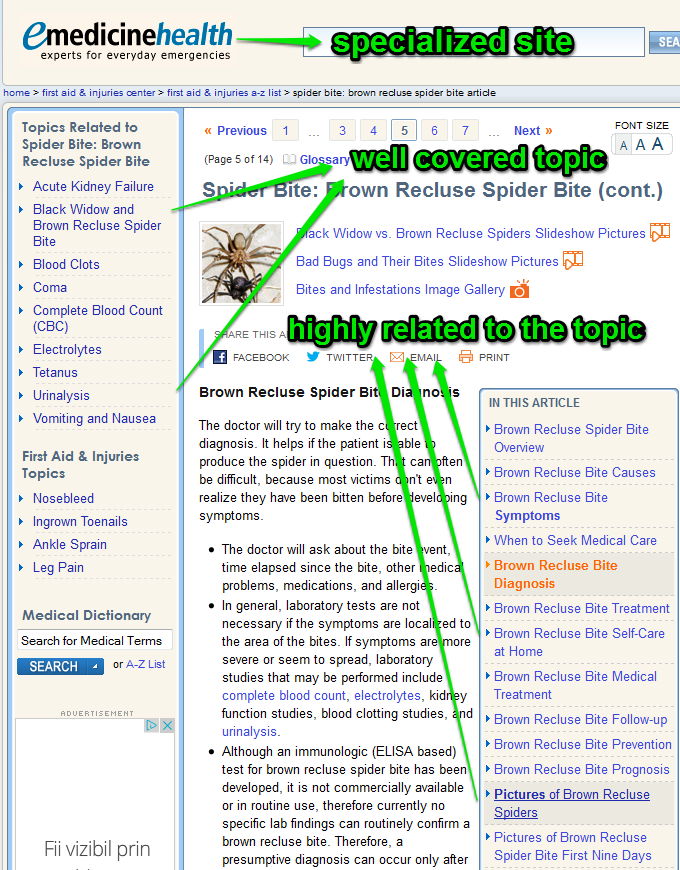
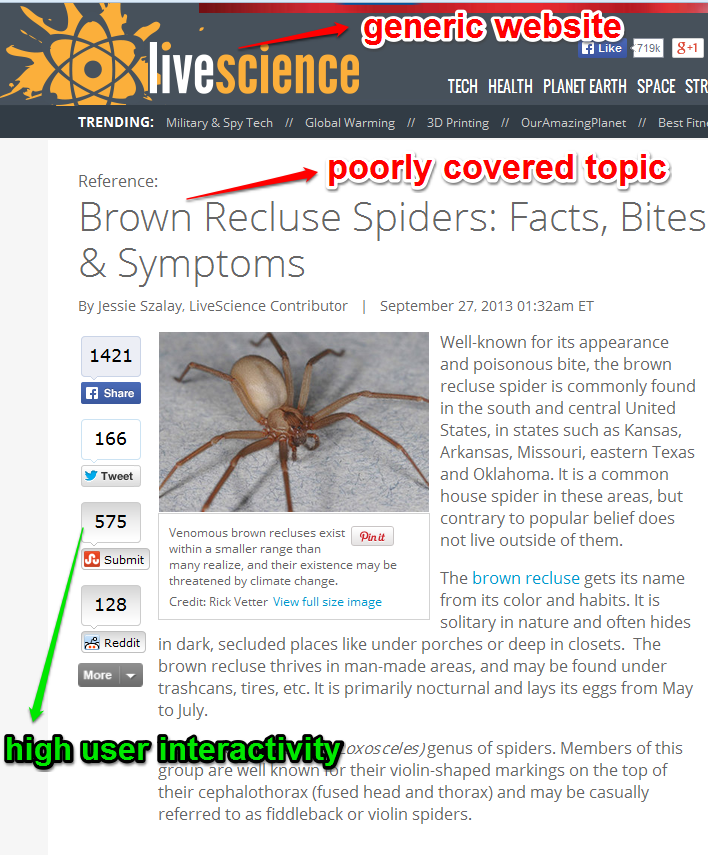
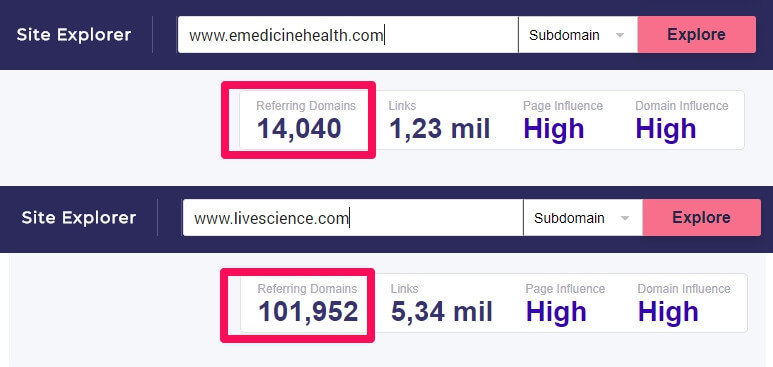
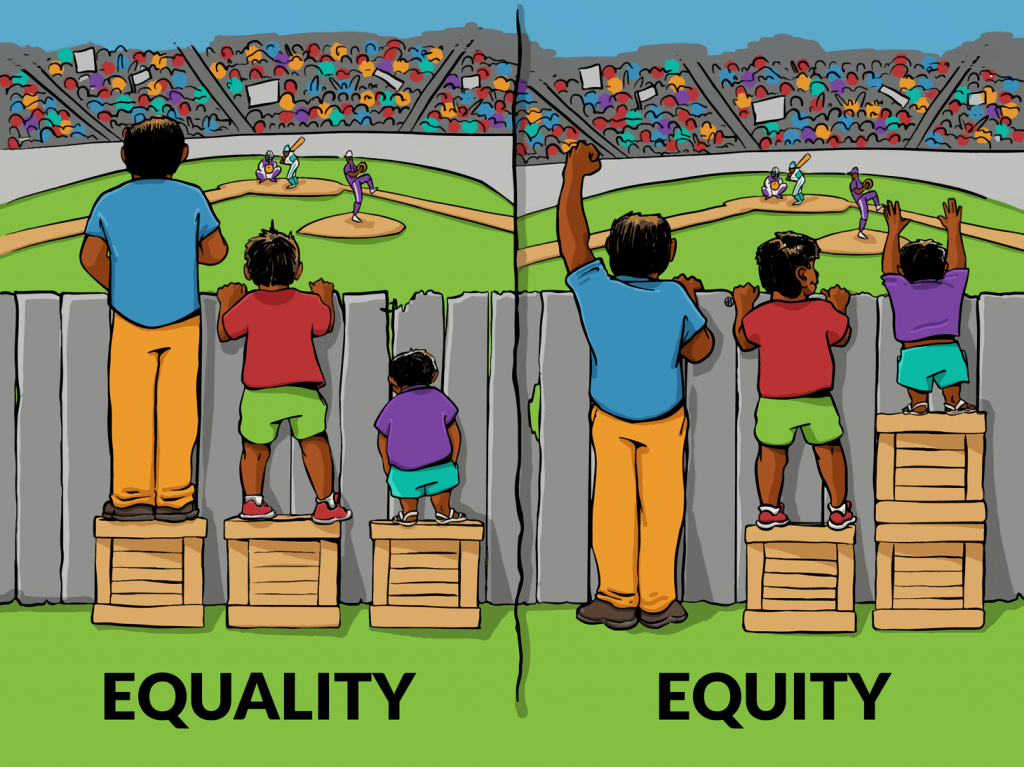
SEO writing has become an adventure, a complicated math problem we are all trying to calculate for finding the secret to get results faster. The number of search engine factors have advanced, the Google algorithm updates has increased, the number of businesses that use SEO have increased, the number of SEO agencies have increased and more and more people have become aware of its importance. That’s how the market got pretty cluttered and the competition very high. And we know how important it is for you to stand up in the crowd.
There are some things that are still available in terms of SEO, and also lots of new ones. We’ve put together a guide to find out how to write for SEO in 2020 and beyond. This way, you can make sure you remain at the top of the pile.
- What Is SEO Writing?
- Why Is Writing for SEO Important?
- Basics of SEO Writing
- What Is an SEO Copywriter?
- What Skills Should a Content Writer Have?
- How Does Content Performance Impact SEO and Rankings?
- How to Write for SEO? [TL;DR – Best Tips]
- Guidelines for SEO Copywriters
- Keyword Research for Content & SEO Writers
- Understand the Search Intent of Your Visitors
- What Type of Content Do People Search in Google?
- Find (Evergreen) Content Topics That Pass the Test of Time
- Double-Check for Duplicate Content on Your Site
- Make a Summary List with All the Information Gathered
- Craft a Content Template Having User Experience in Mind
- Include Tags in Title and Body
- Write In-Depth and Relevant Pieces of Content
- Animate Your Text by Adding Images, Audio, Video Content
- Make Use of the Power of Internal Linking
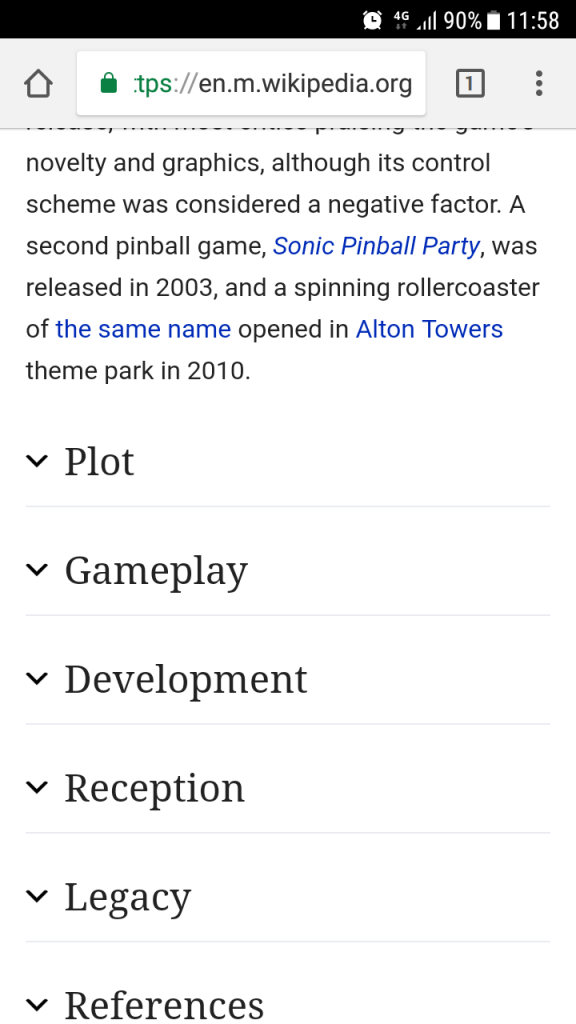
- Make Your Content Mobile Friendly
- Create Google Friendly URLs
- Spread the Word
- How Important Is It to Update Content on My Website?
- Should I Delete Underperforming Content from My Site?
We’ve put or hands to work to let you know everything there’s to know about SEO copywriting, from Q to M (keyboard letters arrangement). Leaving the copywriter jokes aside, let’s focus on the how to write for SEO, the basics, and finally the steps to get the Wonderland of first positions on Google.
1. What Is SEO Writing?
Writing for SEO refers to a technique that pleases not only the reader but the search engines as well. The standard type of copywriting relies on storytelling, on descriptive information, on niched content based on the knowledge of the audience. It is also known as copywriting with SEO in mind.
SEO writing is a process of writing that helps websites rank higher in search engines. By combining copywriter’s creativity with processes website content can stand out quicker in the major search engines.
Writing for SEO is a pretty straightforward process. It requires content strategy, well-researched data and discipline. You’ll have to perform keyword research to understand the intent of your audience searches and find out what type of content your audience consumes, spy your audience and find the competitive advantage – the content gap.
SEO copywriting combines three important elements. Similar to the successful trio – the three wise monkeys 🙈🙉🙊 – it creates a synergy between:
- Information Gap
- Audience
- Google (or other search engines)
There are also other approaches on this matter, like Kim, the Marketing Director of Alexa, has another approach to the essence of SEO copywriting:
| SEO copywriting is probably more of an art than a science. |
 |
KIM KOSAKA |
| Marketing Director of Alexa |
2. Why Is Writing for SEO Important?
Writing for SEO is important because it’s a one of the best ways you can make sure your content will reach your readers. Search engine optimization is the ticket to the Wonderland of first places in Google. Otherwise we would write in vain. People wouldn’t find your content, and it wouldn’t serve anybody, nor the users, nor the search engines (which is the way users get to your content).
So, wouldn’t you want to take part in this beautiful adventure and get there?

Creating SEO friendly content is important to help your audience, build organic traffic to your website and keep your loyal clients. SEO keeps the business running. While other ways of distributing content and paid ads bring you clients as long as you keep investing money, SEO is used for long-time strategies that maintain your website visible in search and needs less financial investment. To reach top positions and remain there, you’ll have to do more than writing content.
Your content needs to:
- be optimized;
- contain the natural language of your visitors;
- understand their pain points and offer solutions, answer their questions.
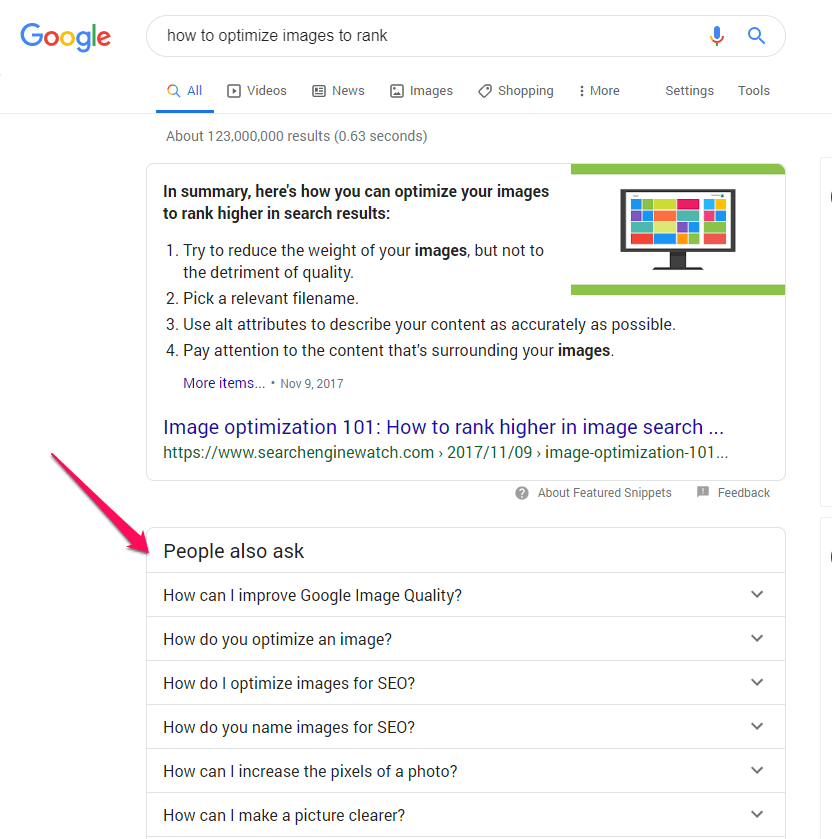
On the last matter, Google offers directions for every query you search and shows possible questions that people also ask.
To implement a long term strategy for SEO content, you’ll have to understand its basics.
3. Basics of SEO Writing
If you got until this point, you need to understand that we won’t provide secret tactics, shortcut tips that will bring you instant top positions, huge volume of organic traffic or thousands of links. Instead, we provide a well-documented strategy that has worked for us and other SEO pros numerous times, but it requires effort. Results are coming, but not effortlessly.
To get great results, you need not only knowledge, means, tools but also an SEO copywriter, a person that needs to have the skills to do things right.
3.1 What Is an SEO Copywriter?
An SEO copywriter writes content that is optimized for a website to rank on top pages of the search engines. If a copywriter writes copy for the sole purpose of communicating a message, develop an idea, describe a situation or an event, an SEO specialist analyzes, examines and tracks results for a website’s content to boost search engine rankings. His main role is to resolve any issues that might block the website from ranking higher.
The copywriter who writes with SEO in mind combines the jobs of those two players. He uses the means and strategies of the SEO specialist to communicate the way copywriters do and reach lots of readers.
SEO copywriters vs. traditional copywriters write content that also tackles the interest and search intent of a person. This drives more visitors to a page compared to traditional way of writing.
An SEO content marketer has the ability to turn a simple article into a piece that is written for the user and it’s beautifully optimized for Google. For that, an SEO copywriter needs to have lots of skills.
3.2 What Skills Should a Content Writer Have?
Since SEO copywriting combines a more complex strategy, all SEO copywriters should know how to write, have a unique voice and a particular writing style. The SEO content writer needs to understand the audience and spy on the competition.
Becoming an SEO writing expert does require more organizing and management skills because they should know what topics to approach, perform keyword research, competitive analysis, take actions and come up with suggestions. That person should also know what topics were discussed on the blog, come up with re-writing ideas or create fresh content if needed. And that doesn’t stop there. That person should take into consideration all the content on the website – product pages, the homepage, the about page and other category pages. An SEO copywriter should evaluate the whole website.
The content marketers need to come up with ideas and techniques, such as content pruning, content amplification, content syndication, content curation and many more. They can also create hybrid techniques to boost the power of content and make it convertible.
A content writer should develop skills for finding new blog content ideas, listen to the readers, ask questions, accept criticism, answer questions and even come up with ideas to repurpose content.
3.3 How Does Content Performance Impact SEO and Rankings?
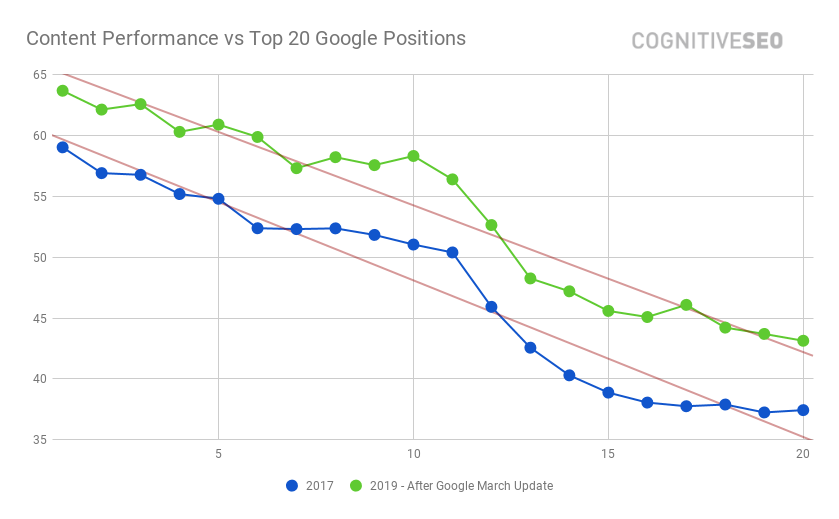
Based on a research we’ve made on 3,784,369 pieces of content, it turns out that content impacts SEO and rankings. We discovered that a high Content Performance score is correlated with top rankings in Google. Check out the chart below.
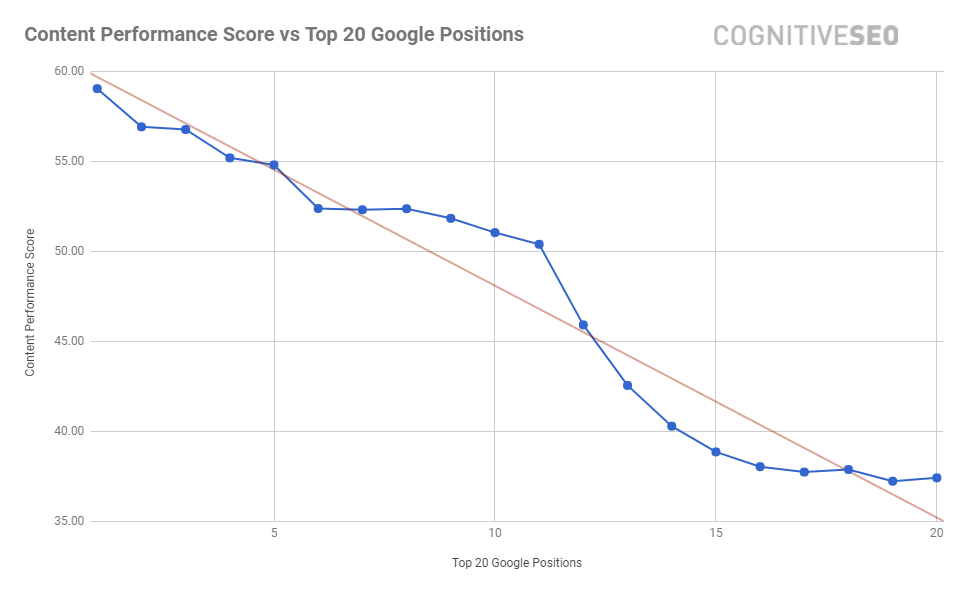
As you can see, there’s a direct connection between the Content Performance Score and the keyword positions in Google. Pages with a higher score experienced higher search positions. And the importance of a well-optimized piece of content increased. At the moment, it has become one of the most important ranking factors.
As you can see in the print screen below, in 2017 the content had a big impact on top Google positions, but in 2019 it seems that content’s importance is bigger than ever.
cognitiveSEO’s Content optimization tool offers a Content Performance score based on how well optimized a piece of content is for a targeted keyword. The content tool is really simple to use. You’ll have to add the focus keyword or phrase that you are targeting and then add your piece of content. Below you can see a printscreen from the Content Optimizer. On the left side, you have the content and on the right side you have:
- The content performance score which shows you how well a page is optimized from a content point of view, on a scale from 0 to 100. The higher the score, the better optimized the content.
- The position on which that content might rank given by the content performance metric.
- The type of search intent – there are three types of content: informational, navigational and transactional.
- The analyzed keywords: displayed in three categories, such as keywords that are already added, keywords you can add once and keywords you should add more than once.
- A section on people also ask: extracted from Google search results, as we previously discussed.
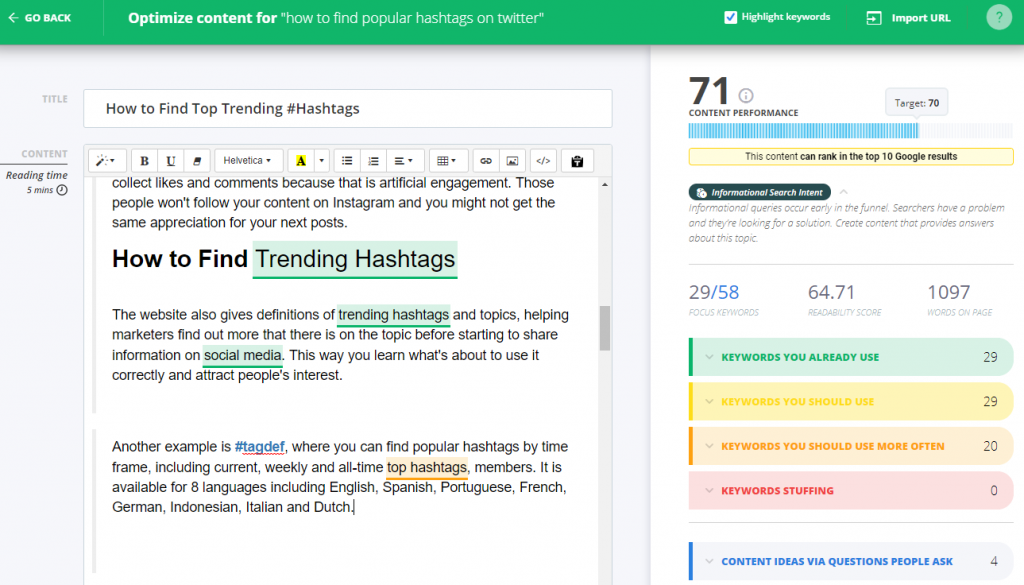
The tool is very helpful in optimizing the content for the search engines but also keeping your focus on what users want to find out by looking into “content ideas via questions people ask”.
4. How to Write for SEO [TL;DR – Best Tips]
Now that you’ve understood what does writing for SEO means, it importance, and the influence of content on rankings, it’s time to move forward to the strategy of writing search engine optimization friendly content.
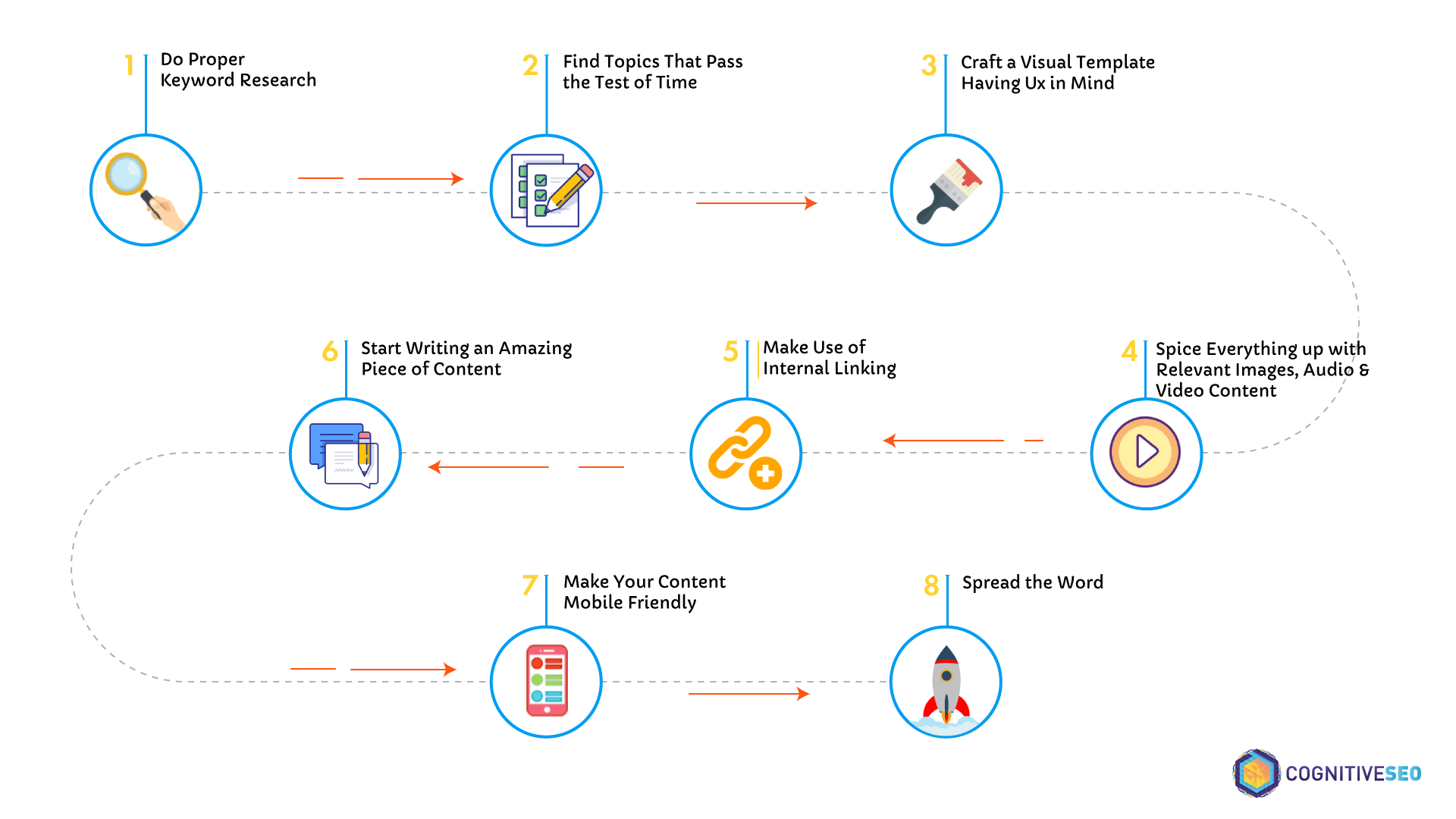
Below you can find some steps to understand how to write for SEO plus some steps to get you going:
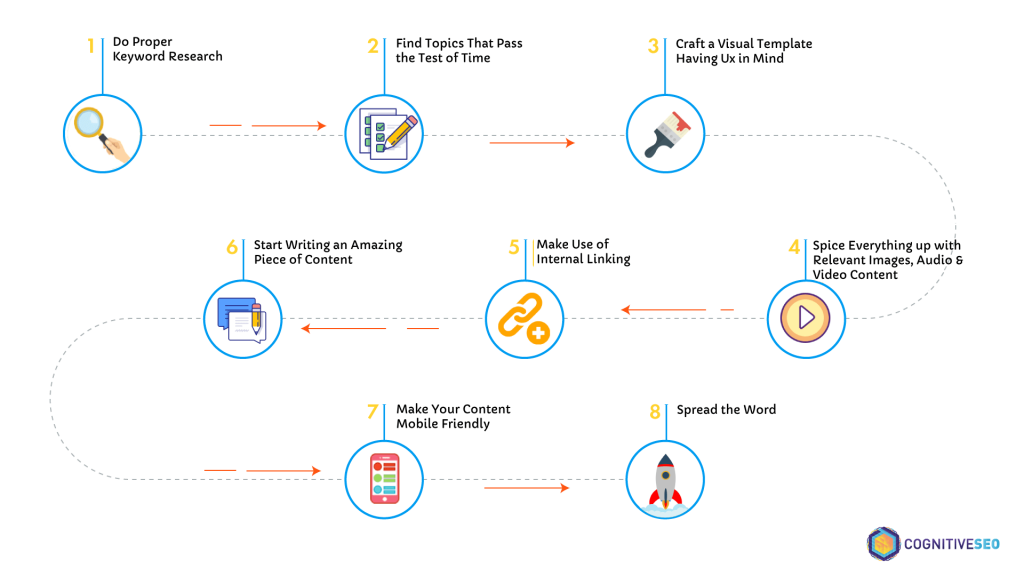
For better knowledge of the process, observe the following SEO writing tips:
- Elaborate a descriptive terminology and build compelling content by finding topics of interest and the killer questions people ask on specific topics.
- Don’t try to build content for topics or noisy environments where there is a saturated niche with way too much content.
- Find content gaps by spying your competition in search on certain topics. See what others are writing and come up with better content.
- Understand the context of your potential customers’ search and fill in the gaps.
- Find out the search intent and deliver appropriate content. For a single keyword, there might be lots of topics. Take, for example, the keyword rock – which can be about music, geology, radio station, and more.
- Try as much as possible to find evergreen content topics.
- Build various types of content: how-to, video, white papers, lists and more.
- Don’t stick to old tricks, but rather look for delivering new content, but also update existing articles.
- Make a structure or summary for your content once you decided upon the topic.
- Add beautiful visuals to your piece of content.
- Make sure you do internal link building within the webpages of your site.
- Check your site for duplicate content and other content related problems and fix the issues with an SEO audit tool.
- Check user experience and design a fast website, by following Google’s guidelines (using the Google Speed Test Insights and Lighthouse).
- Create a mobile-friendly website or use CMS (such as WordPress) that are designed by default to be device friendly.
If you want to go in-depth you can check this big list of copywriting tips that are designed to boost conversion rates.
Before moving to each step and learning how to put into practice those tips, it’s important to understand the role of your audience.
We’ve said it lots of times before, and we’ll continue to say it as long as everybody understands the importance of its meaning:
Content must be written for the user; you should write content for people.
Contextual content is the latest approach in terms of writing for SEO at the moment. It is one of the important changes that took place in the last period. Lots of SEO experts talk about semantic and context-based results.
5. Guidelines for SEO Copywriters

After we’ve got you these preparation steps for gathering all the information and SEO tips that you need to make a great piece, you’ll have to put to work your writing style and skills. Remember the SEO copywriting techniques and write an outstanding article. Here you put your magic into action. The content creation process begins.
Besides the natural language and creative abilities, some SEO technicalities are almost mandatory for success. Writing SEO friendly blog posts can be difficult and time-consuming. However, it’s time well spent, as SEO helps us rank better in the search engines.
Correct grammar, descriptive topic where you reach all the points related, personal opinions, real conclusion and unique content are necessary for creating highly readable web pages.
5.1 Keyword Research for Content & SEO Writers
The first step in SEO content writing should be keyword research. Deploying the topics of interest and the killer questions, we can elaborate a descriptive terminology and build compelling content. Searching for primary or secondary keywords will help us describe the topic at its best for the users and make it optimized for search.
Finding keywords shouldn’t be hard, yet it’s not a walk in the park either. You need to have a starting point and based on the targeted keyword, you can find many derivatives. Some tools can help you find the best examples and generate organic traffic. The Keyword Tool and Content Optimizer is an awesome helper on this matter. It’s like your best buddy you can call in the middle of the night to get you out of trouble. You can find new topics ideas and related keywords to the one you are targeting, as well as the questions that people are asking related to your topic.
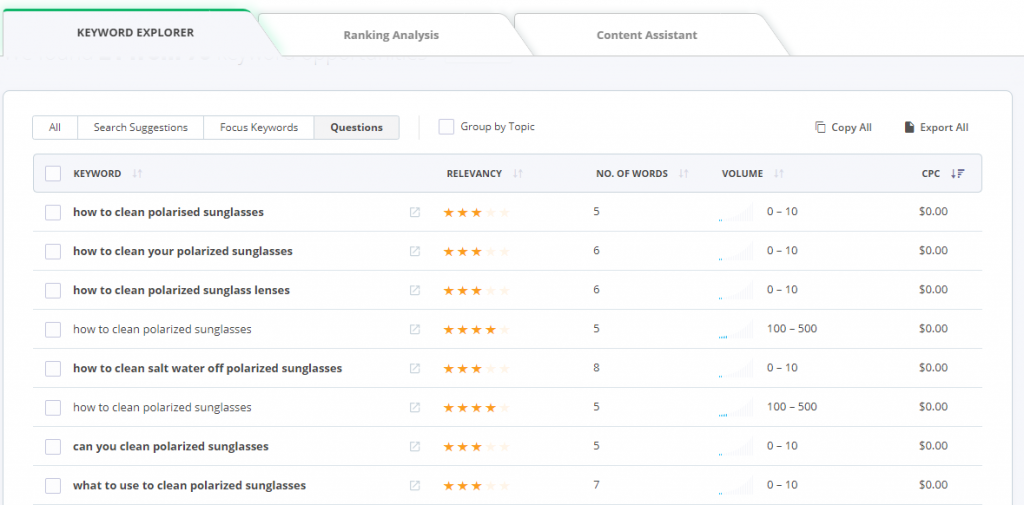
We are talking about producing content for SEO, which means valuable, evergreen and quality all-in-one. For that, you need to raise your head up the crowd and don’t get flushed away by all the people that are “writing” and creating worthless content. There are lots of noisy environments with “too much” SEO content.
| Without a strategy, content is just stuff, and the world has enough stuff. |
 |
Arjun Basu |
| Award-nominated author |
You have to become an SEO content writer, not just a simple writer for succeeding at SEO. You need to ask and answer the right questions so that your content helps the users and keeps them on the page.
| Valuable content is found at the intersection between your customer’s needs and your business expertise. |
 |
Sonja and Sharon |
| Founders of ValuableContent |
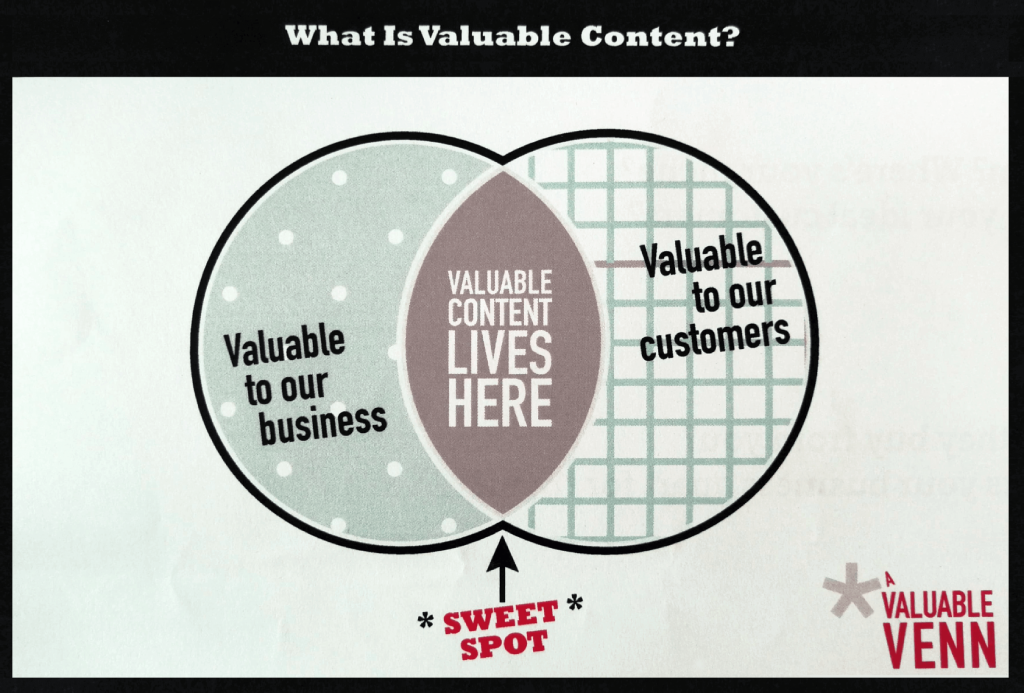
Source: www.valuablecontent.co.uk
Valuable and quality content breaks the glass and goes beyond the screen. Imagine that your visitors come from all directions and you need to make them feel that they’ve come to the right place. They need trust, so you’ll need to offer the information they need and think: “Wow. This is the place for me. Somebody really understands me.”
5.1.1 Understand the Search Intent of Your Visitors
To get to the previous situation described above, you’ll have to understand the context of your potential customers’ search and fill in the gaps. It’s mandatory to know your potential customers’ needs and interests to understand the search intent afterward.
Google discovered that the conventional keyword search, as we know it, has some limitations and doesn’t offer topical results based on the query search. For a simple keyword, there are lots of related topics and information available online.
Google has developed patents to understand context from knowledge bases for more accurate results. It wants to focus more on topic-related results, so the whole process works based on probabilities. For example, when a user performs a search on Google, the search engine uses a system to return landing pages with topics related to the query by looking at the text on that page.
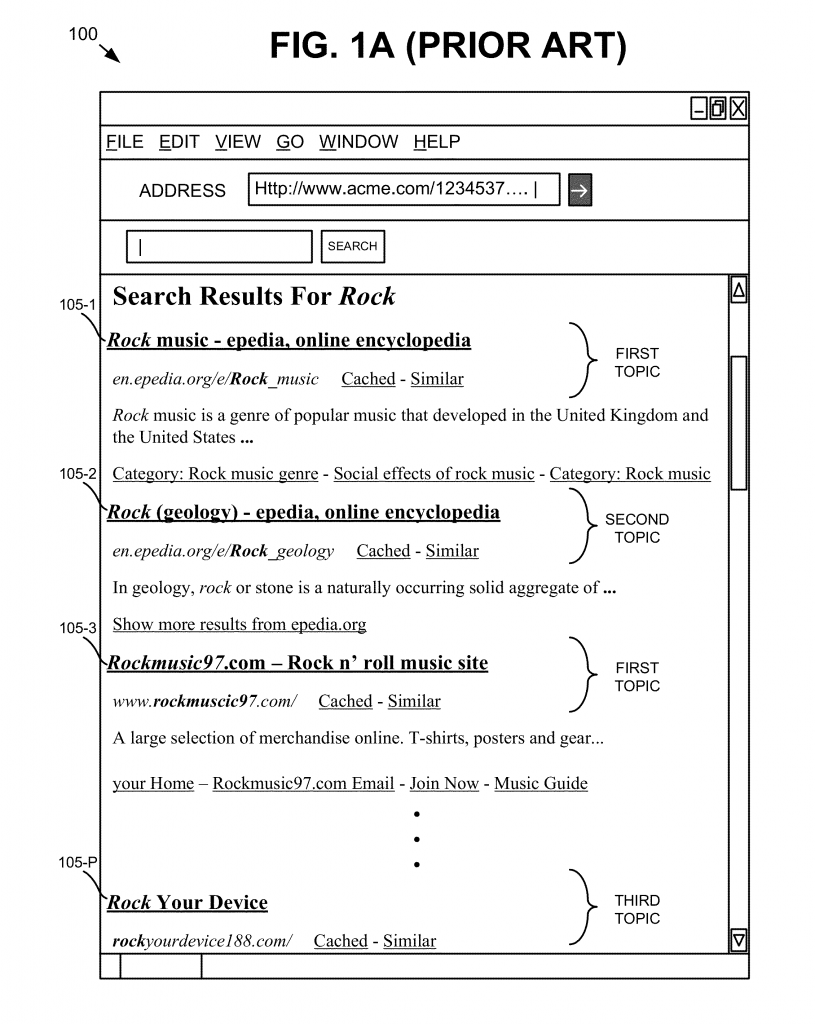
You may ask how you can take advantage of that and get ideas for contextual keywords. Focus on the user, the user’s search intent and how to steal their heart and convert them.
Let’s take an example. You have a pastry in the US and have a new recipe of cronut. For those who don’t know, a cronut is a croissant-doughnut invented by a pastry from New York City.
We used the Keyword Tool and Content Optimizer for this example. We searched for “cronut” and below you can see the results, starting first with the keyword suggestions:
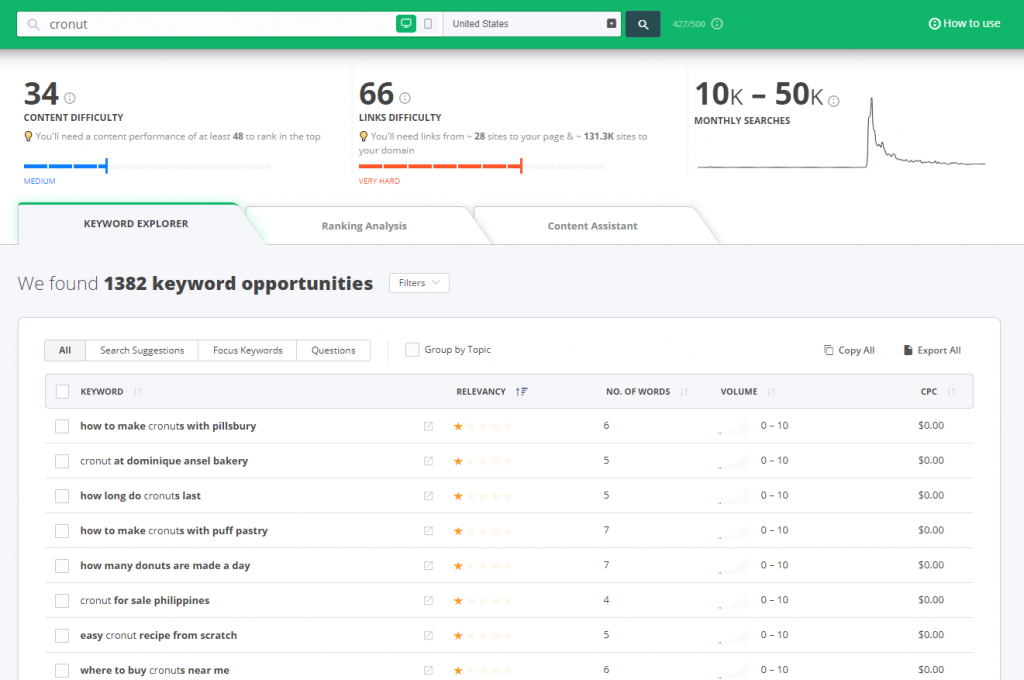
Based on our example, you can see what people from the US searched for on desktop. Most of the keywords are informational, which means most people want to know and understand what cronuts are. If your target audience already knows about them, then choose directly the keywords that are more relevant and descriptive, such as: “easy cronut recipe from scratch”, “how to make cronuts with puff pastry”. Based on these two keywords, you can perform other searches to find more relevant keywords. Filter the results based on relevancy or volume.
Since we’ve talked about context, then it’s essential to collect as many keywords as possible and select a topic in the second step. When we get to the onpage optimization part, you’ll need focus keywords. Don’t end up with just one keyword, look for a second keyword, similar to the first one.
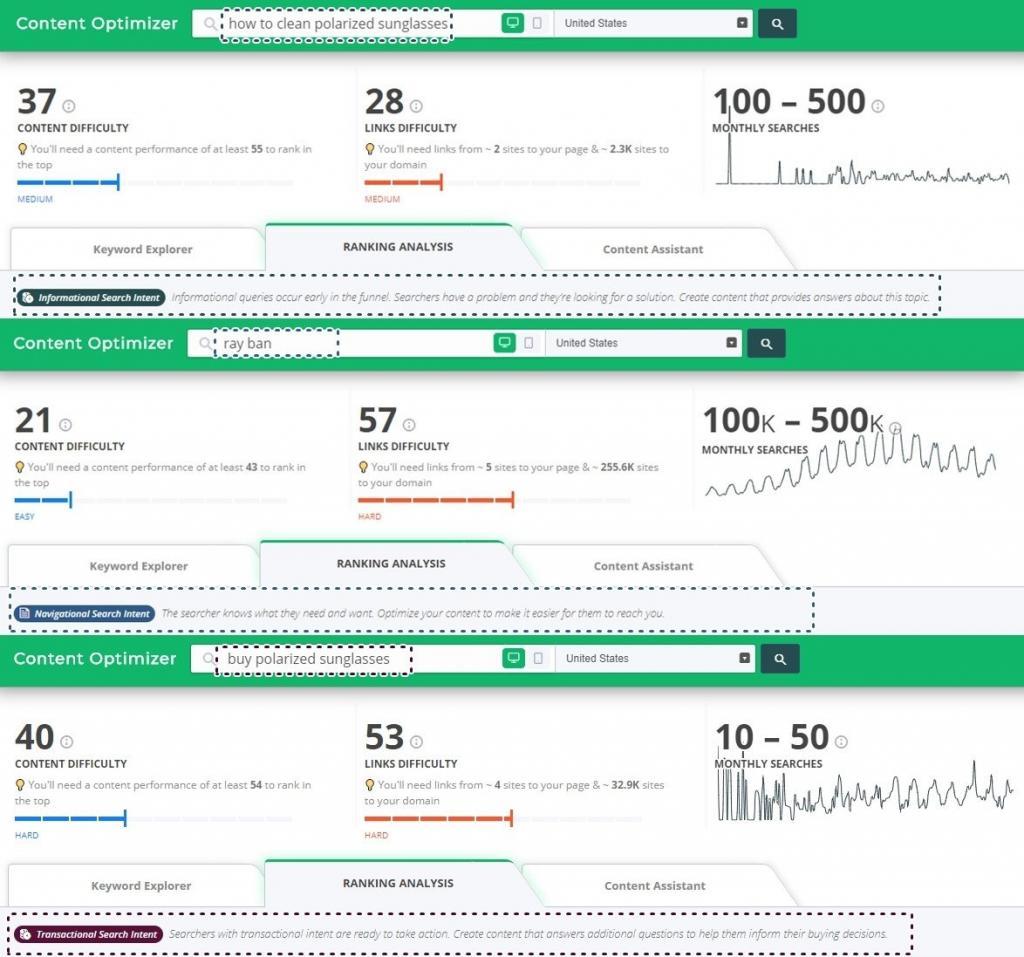
Since you want to tell the world about your new cronut, there are multiple ways to do so. But first, you need to understand the search intent of your visitor. For that, you’ll have to look into Ranking Analysis. For each type of query, you can see one of the following types of search intent: informational, navigational or transactional. Based on your keyword search, you’ll have to write similar content: informational, navigational or transactional.
It is very important to decide on the keyword before writing the content, to deliver the type of content asked for and needed by the users.
If you go with the navigational type of keyword, then search for the keyword and see the volume and who your competitors are. If you go with the first type of content – informational, then check to see what other people are searching for.
5.1.2 What Type of Content Do People Search in Google?

Before actually starting to so SEO writing, your first step is to understand what type of content users want and Google encourages you to write. SEO and content go hand in hand.Usually, users search for something on search engines because they have a desire, and want to find answers and information.
Finding the reason behind it requires deeper SEO analysis and Google is using context to show better search intent results. And your job is to create the right type of content for your users and for Google to rank it.
We can agree that on a larger scale, there are three types of content:
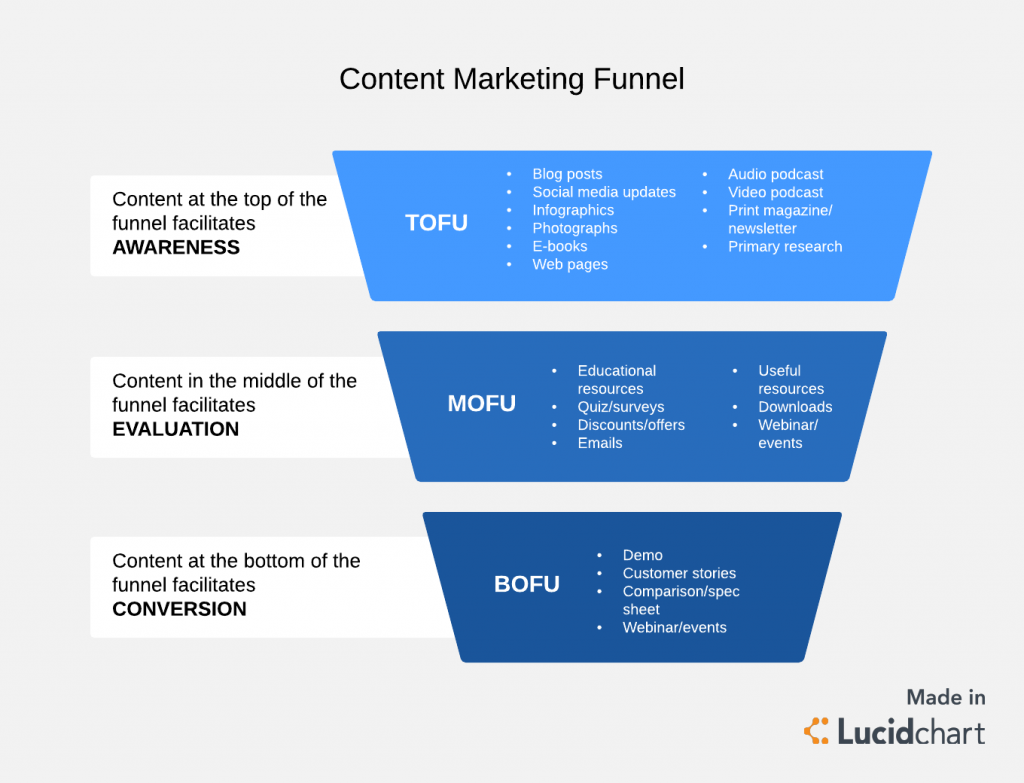
- TOFU content delivers informational content
- MOFU content delivers transactional content
- BOFU content delivers navigational content
In the screenshot below, you can see what each of these acronyms mean.
What is top of funnel content (TOFU)?
Top of the funnel content is that type of content that offers information and tries to teach the visitors, answers common questions or pain points. At this stage, you don’t try to sell to the visitor because you might risk losing them. At all costs, avoid commercial content for this audience. TOFU content is used mainly for attracting new prospects and build awareness.
What is middle of funnel content (MOFU)?
Middle of the funnel content lays between quality content that keeps the users informed and their understanding and need of your services or products. It is a key piece in your content marketing strategy. You can deliver MOFU content through case studies, personalized white paper that includes your business solutions, product reviews and best practices, discounts, webinars, events, surveys and so on.
What is bottom of funnel content (BOFU)?
Bottom of the funnel content is at the purchase level, where you have brand loyalty and users see in you their loved brand. It comes after TOFU content and MOFU content as validation for delivering valuable content that responded to your clients’ needs. It is the type of content where you nurture and convert your lead magnets into customers. With the right data, you can increase your conversion rate. BOFU content can have different forms, such as live demos, customer stories and personal reviews from clients, comparison products, new product or features launch and so on.
Your audience can be divided into all three stages of the buying funnel: top of funnel (TOFU), middle of funnel (MOFU) and bottom of funnel (BOFU). For each stage, there are specific triggers that pull the visitor down the funnel. And for that, you need to create content that will convert them.
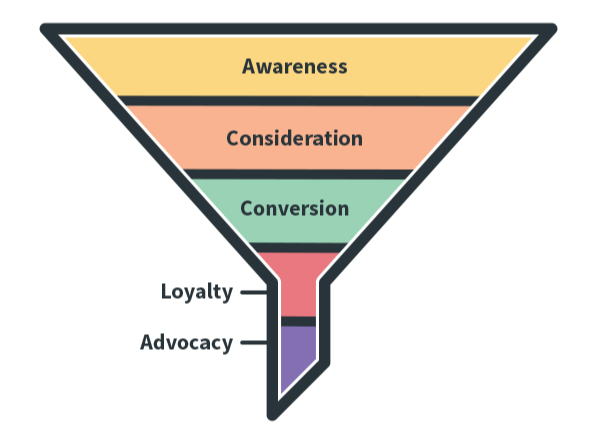
Source: www.aweber.com
The perfect content needs to deliver information based on the stage of the content marketing funnel where your audience is. For that, you need to know what type of content works best for all those three stages.
5.1.3 Find (Evergreen) Content Topics That Pass the Test of Time
The second step in the research phase is finding topics that keep pulling people to your website. Usually, the articles that are evergreen have information that doesn’t alter in time. It is the type of content that solves a problem a lot of people is struggling with.
In the example above, I was talking about cronuts. For some, it might be an old story, but for others a new discovery. It is unique comparing to other types of deserts; it has two things into one. That type of product/topic might be what makes it last. When it first appeared in NYE, people stood in line for this hybrid. Nobody knew how it tasted, but everybody was intrigued. So the mystery draws attention and uniqueness keeps it alive. Word of mouth was a good trigger. The lesson here is that you need a topic that will engage the community.
You can draw attention to a dull product from a boring niche. You just need a creative idea.
| There really is no such thing as a boring subject. Just boring, unimaginative writers. |
| |
BEN HURT |
| |
You can create a recipe with steps and tips because, according to the research, there were lots of people who want to find out how to make a cronut. The basic recipe won’t change, but there will be variations to it. So people will go to basic before trying something new for the first time.
There are some other tricks you could use to take advantage of content immortality:
- appeal to the historical evolution of a certain product/topic/service and so on;
- create how-to guides or helpful documents;
- make a list of frequently asked questions;
- share best practices;
- write strategies;
- elaborate case studies, studies results and examples;
- best of niche blogs, influencers, experts – for outreach;
- explain the history of your business or your success story;
- create correlations with other industries, find inspiring ideas.
I got my inspiration after I read an interesting blog post on the furniture store Furniture of Dalton’s blog, entitled Sofa Story: A Brief History of Ten Iconic Forms. And after reading it, I thought that article might be a very good example of how content evolved. And the Sofa Story can be correlated to content evolution, with a more visual effect.
In the early days, sofas were hard, harsh supports made out of stone, wood, steel and lots of other material without any cushion. Over time, they gained popularity, and some types of sofas started to become a little too tawdry, with lots of cushions until they made their way to a more contemporary soft seating in a range of styles.

Roman sofa made of Terracotta (form the second half 4th BC) displayed at Louvre

Grecian couch (from 1825) displayed at High Museum of Art, Atlanta

Modern sofa you can find in stores nowadays
If we were to compare it to content, it pretty easy to see the similarities; content started small, then there was the keyword stuffing era, and afterward, it got more accurate and harmonious.
You’ll have to study the competition and see what their focus is, to outrank them. Competition might be very high in some niches. The Keyword Explorer is here to guide you. For a specific query, the ones that we’ve discovered above, we can see the type of query we pursue – and easily get more insights on the user intent.
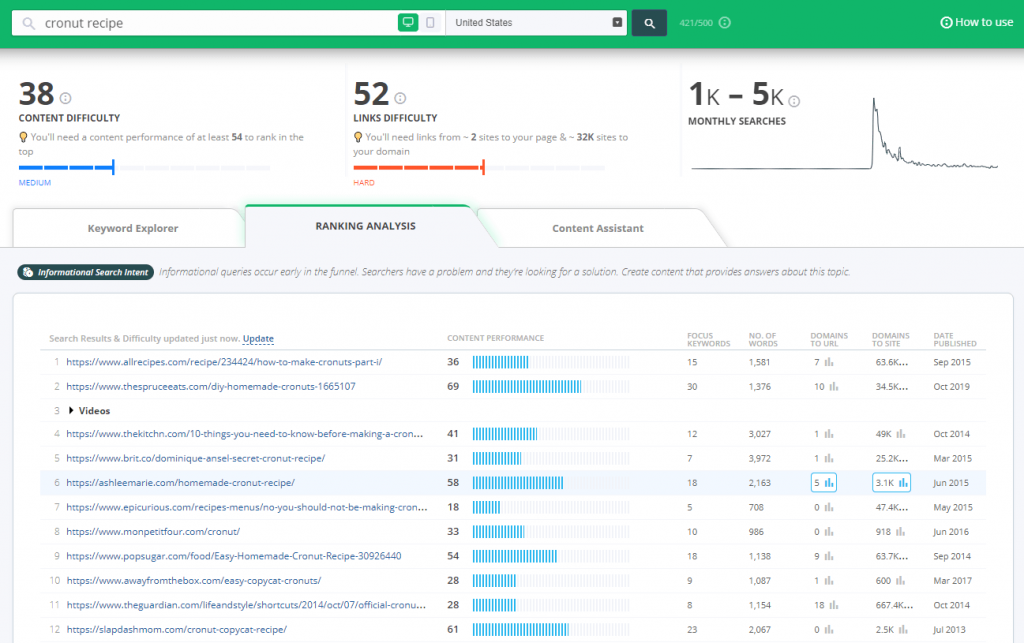
In our example, we have an informational query. Looking at the competitors, we can see what SEO pages are ranking. Skimming through the first ten pages, we find lots of cooking blogs, a video tutorial for a magazine (that ranks twice – once with the video from Youtube, and secondly with the article published on-site).
In this case, we see what our competitors are and get inspired by them. Since you are a business, you can write your pieces of content using more unconventional methods. Remember how important visuals are in this industry. Numbered, highlighted or bulleted steps make the recipe appear simpler and easier to make.
5.1.4 Double-Check for Duplicate Content on Your Site
Even though there’s no duplicate content penalty caused by content duplicate issues, it is quite damaging for your site. If Google finds duplicate content, it might not feature your piece of content in the search results. Google throws your content into something often called Google Omitted Results.
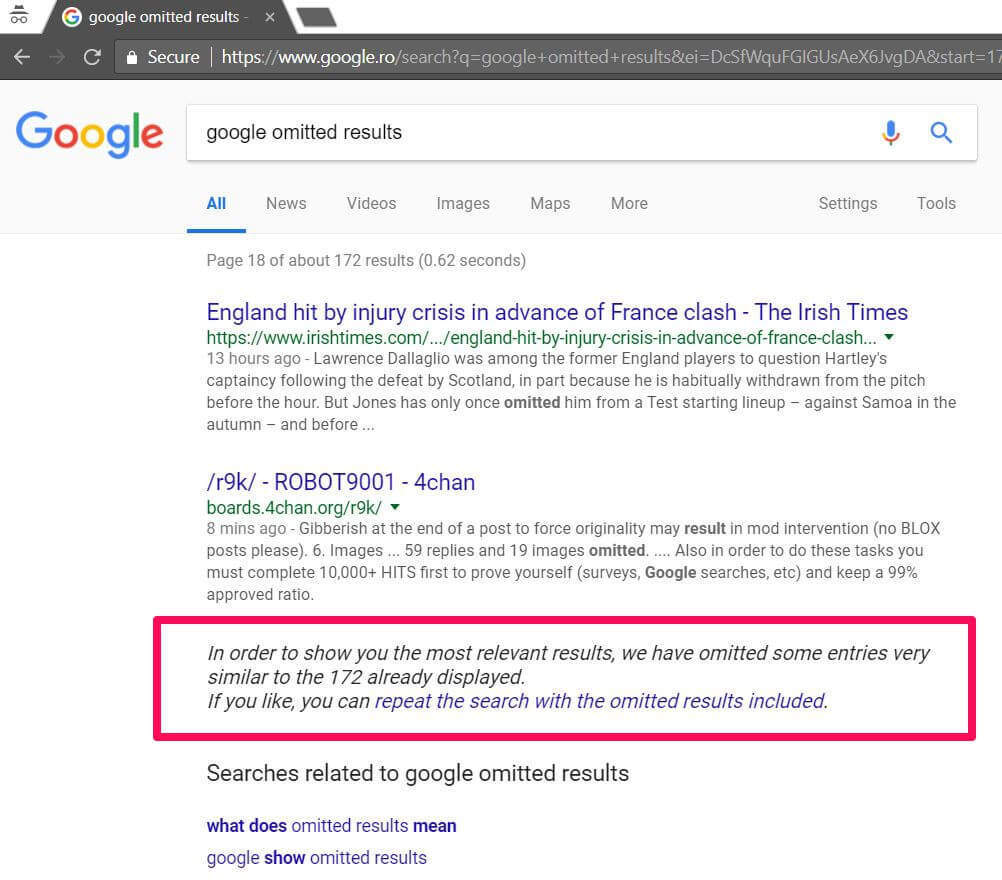
If you SPAM the web all the time, it might even consider not indexing your site anymore. And since nobody would want that, learn how to avoid having duplicate content on your site.
As a general rule of thumb, Google tries to display only 1 version of the same content.
Unfortunately, Google Search Console no longer allows you to see your duplicate content issues. Some time ago, this was possible, but Google “let go” of this old feature.
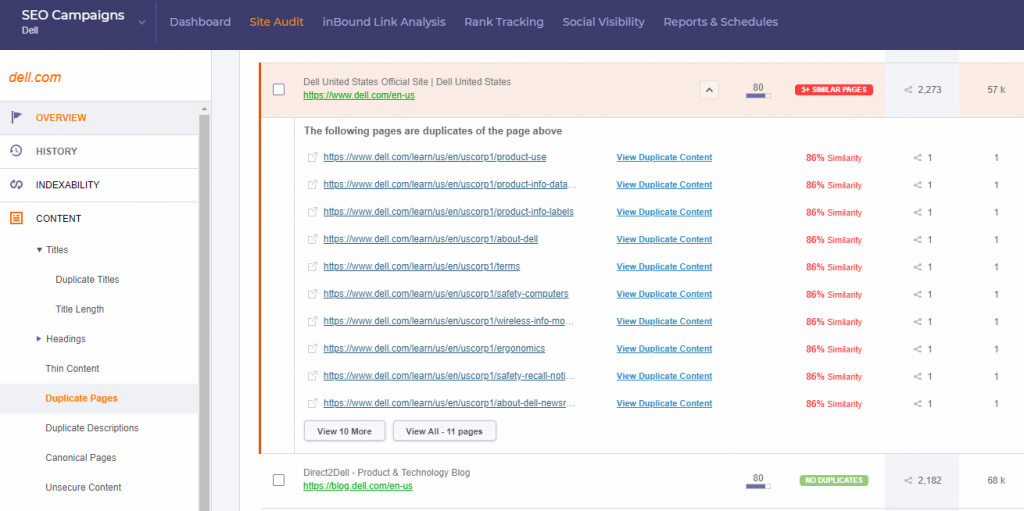
One way to detect duplicate content is to use the cognitiveSEO Site Audit Tool. The tool has a special section for that, where it automatically identifies any duplicate content issues. Therefore, you can quickly take a look at your duplicate pages, duplicate titles, descriptions, etc. More than that, the tool has a section that identifies near-duplicate pages and tells you the level of similarity between them.
5.2 Make a Summary List with All the Information Gathered
Once you’ve collected your focus keywords and the words and phrases recommended by the tool for your SEO article, you can make a list. A simple document is enough. My method is pretty simple and you can use it in your own writing process.
- First, I write a topic or title (that will be modified when I finish the article).
- Then, I add my focus keywords.
- I have a section named ideas or a structure of the article, where I use bullet points for all sorts of information that I want to discuss. Here you can add all the ideas that you have and that you’ve discovered by looking at your competitors because our goal is to create the best piece of content there is out there. Use quotes with the source attached, save URLs, images and more.
- Conclusion/final note – left in blank. This will be added only after I finish the article and I can sum up a final idea based on my findings.
Now you can start working on crafting the content template for your article. Would you follow a basic look or try to make it more attractive?
5.3. Craft a Content Template Having User Experience in Mind

Every article that you write needs to have a creative content template, a natural flow. If we go further with our example, the web content needs clean visuals – images, videos, gifs, and a very important step is to create a cover photo that approaches and has the title written on it. It is easier to share it on Facebook, Pinterest and more. If you can, create a longer picture – similar to an infographic picturing the final look of the desert, if we follow our example, and then the ingredients and steps you have to perform.
Make it simple and easy to follow. Here’s an example:

The way you structure your article is synced with the design of the website. That means the design of your website can make it easier or not to perform some magic tricks with your content. If you’re using an open-source content management system and not a customizable HTML website, such as WordPress, then it is easier to implement a layout.
The way information is displayed has high importance. For a recipe, you need to have the first section with ingredients that need to be separated from the main body of the article. And visuals have a higher significance. Below you can see a good example you could inspire from.
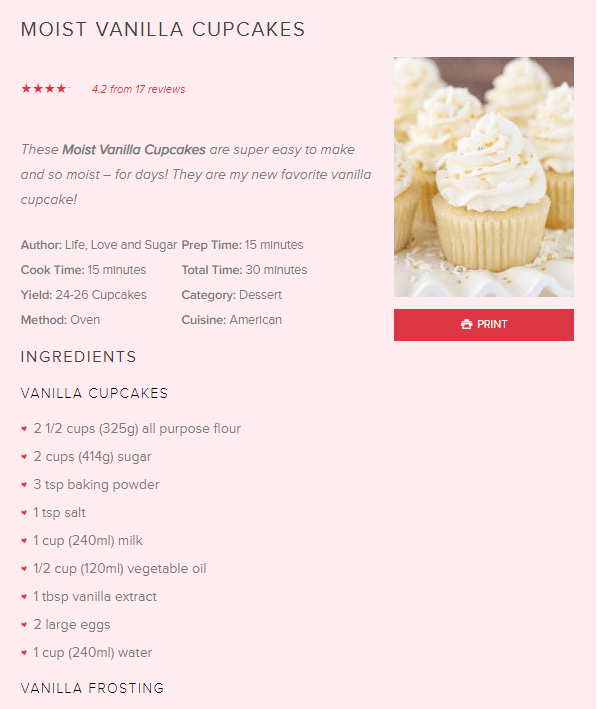
Source: lifeloveandsugar.com
The trick of this page is that Print button which makes it easier for people to have it in physical format. Somebody really knows the audience and their behavior. When you cook, you make a lot of mess and a printed format of the recipe is a very good way to make the content more useful. Lindsay, the blogger of this website, got an extra point for this little feature because her content breaks the virtual space. UX is well applied to this recipe page.
User experience – the holy light that brightens the page and triggers the appreciation of the user. Depending on the type of content, there are some things you shouldn’t miss in order to keep the user and don’t scare them. Beside site speed and optimized images, you should also have sharing buttons (if possible for images have the Pin icon – if visuals have high importance, like in our example for pastries, desserts, and everything related to cooking, in general).
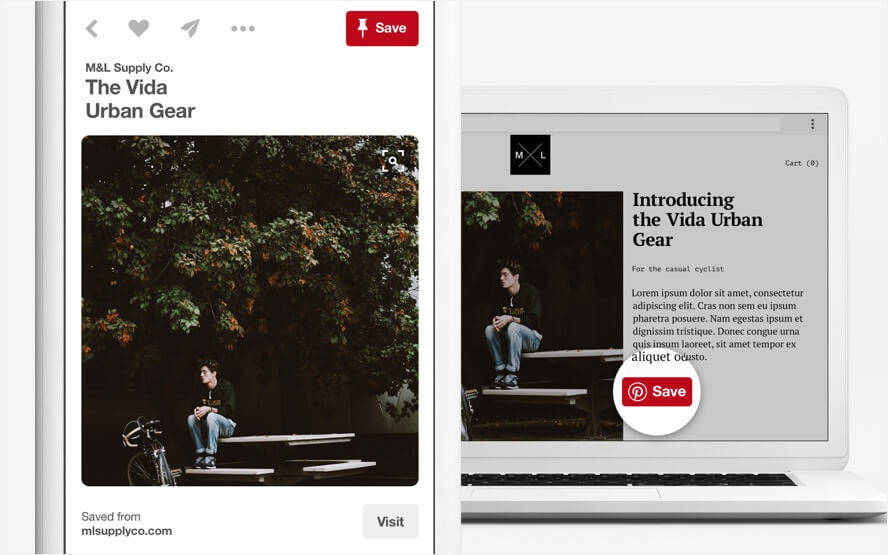
Some other elements that you should keep in mind are:
- adaptable screen resolution;
- simple font with reasonable size and line spacing;
- separate sections of images and text, not overlapping content without white space;
- user location integration for local personalization;
There’s an explanatory image of what UX means, created by Stephen P. Anderson, an internationally recognized speaker.
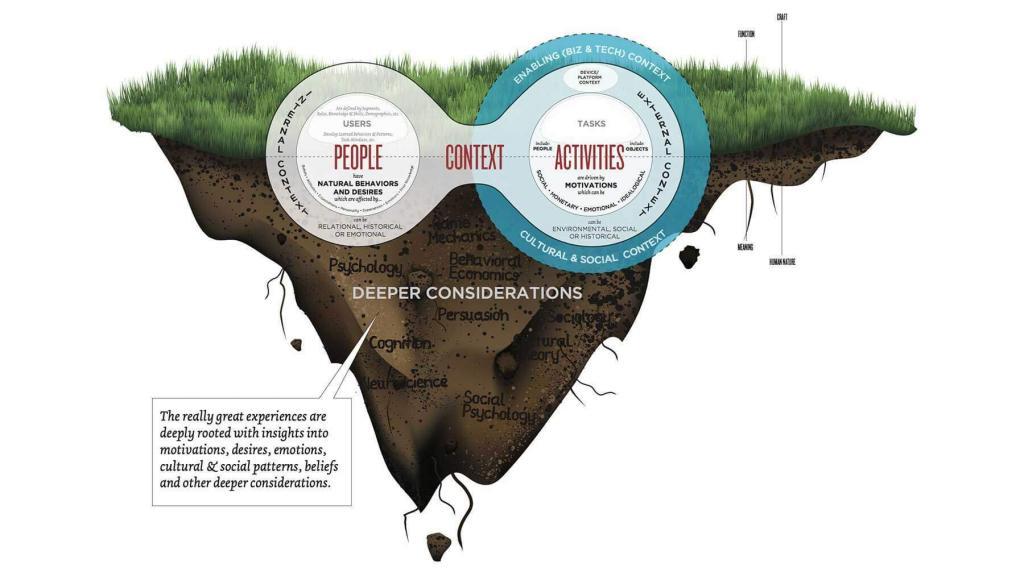
UX also means knowing your user and their behavior, so you can anticipate and give more freedom to use and read your content. Just like the example above, the print button is a great integration for recipe pages.
5.4 Include Tags in Title and Body
In SEO writing, besides content, the title also matters. And for that, there are lots of studies to back up.
Adding the keyword closer to the beginning of the title will give you high advantages. Firstly, because you can increase your click-through rate, as the user would like to click on titles that contain what they are looking for online. Secondly, this way you can avoid that the title to be changed by Google and have a different title shown in SERP. Google does this now. Depending on the search made by the user and what is found relevant on your page, the search result for your webpage as you know it can be altered by Google and you can get a different title and meta description.
Google is smart to understand what your page is about, but it is important you give it some hints.
If you offer good hints, then it will figure it out easier and reward your webpage with better SEO rankings.
The second thing to mention on this topic is the effect of keywords in the title. In one of our researches, we could see if adding the keyword in the title influence rankings. By evaluating titles analyzed in the research, we used 3 levels of similarity (low, medium and high) to spark some light into the discovery and extract data from the first 20 search engine ranking positions.
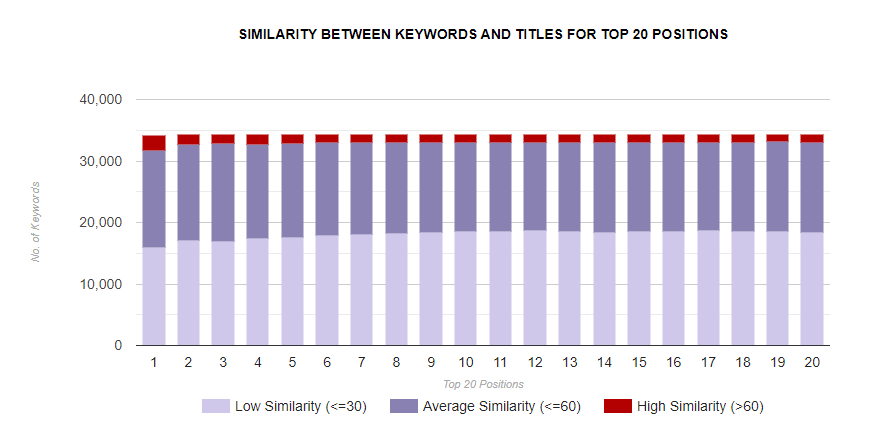
If we take a look at the chart results, we can’t really talk about a high correlation since the differences are pretty subtle. But we can surely get out some insights. For example, mainly the instances with a high similarity can be found for 1st ranking website. The red line is slightly bigger than the rest of the rankings. Moreover, there’s an overall decreasing trend form the 1st position until the 20th position. Which can mean only one thing:
Adding the keyword in the title can make a clear difference between ranking 1st or 2nd.
Another good intake is to try optimizing the title for multiple keywords, if possible. But don’t include keywords just for the sake of it.
Since we are talking about writing for SEO, you need to include tags to let search engines know how your piece is structured. Title tag has a high influence on your piece of content because it will be displayed as the big blue link in search engine results:
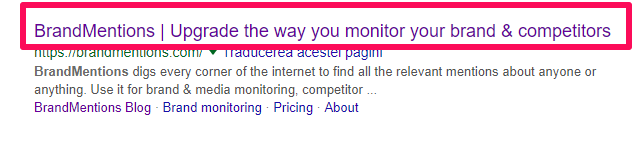
Title tags and headlines are really important because that’s the first thing the user sees. To create compelling titles, follow headline formulas and check out your competition. If you look at your competition, you can see how you can create better headlines and standout.
You need to have a relevant, engaging and attractive title to make the user click on it and stay on page. Also, don’t make a promise from the title that you can’t fulfill in the body content. There might be cases when Google rewrites your title tag with information from meta description and page content if Google doesn’t like the one you added. Chances are this won’t be as good as the one you’ve created, so you must ensure that your own title tag is completely relevant, descriptive, has the right length and the focus keyword phrases included.
There are some copywriting techniques you could follow for generating clickthrough rates:
- Create actionable titles, asking the user’s question: What’s in it for me?
- Use the brand leverage. For well-known brands, it is in their best interest to use the brand name in the title.
- Don’t use title case.
- Create unique title tags.
- The body tag shouldn’t miss. You need to highlight that part and explain to the search engines where the main part of your content is. Where other tags are incorporated, such as heading tags (H1, H2, H3, ..H6), image alt descriptions. There are some other HTML elements that you should integrate for better optimization: URLs and meta descriptions.
5.5 Write In-Depth and Relevant Pieces of Content
Now that you know what type of content you should write, it’s time to actually start writing for SEO and most importantly for your users’ needs.
Google likes in-depth and relevant content.
Content creation is very important, as you already know. The key here is to always add high-quality content on your website. This will improve dwell time by keeping your visitors engaged.
Studies say longer posts are more often associated with better ranks. In one of our researches, it turned out that the top-ranking articles have around 2000 words.
Below you can see the results for the blog posts that have 1001-5000 number of words, amongst other categories.
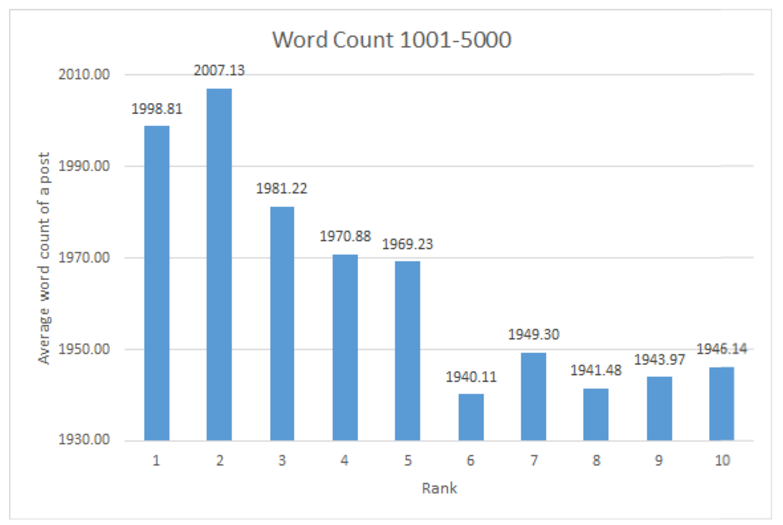
As you can see the number of ranks decreases when the positions drop. The first 5 positions can be set apart from the rest of the pages. It seems that overall a higher number of words are correlated with higher ranks. That is suggested not only by the chart but also by the Pearson Correlation Coefficient, which indicates a very strong negative correlation (-0.9). The negative correlation means that, in general, longer posts are more often associated with better ranks.
5.6 Animate Your Text by Adding Images, Audio, Video Content

Video content can boost your content and increase your conversion rates. If we follow our previous example regarding cronuts, for the query “cronuts with puff pastry,” we have a website that ranks first with the video and then with a webpage where the video was embedded. If you take a look at the print screen below, you can see it ranks in Google both on the first (for video content) and eleventh positions.
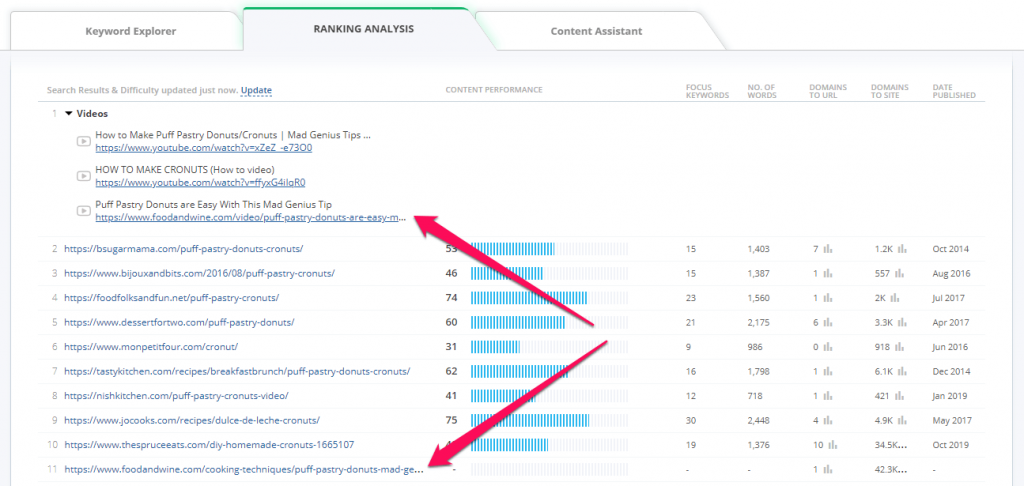
SEO fact: Videos have a 41% higher click through rate than text.
In this case, the video tutorial can push the webpage higher in search engine rankings. Visual content appeals to emotion, creates intimacy, and engages the visitors. A Blue Corona study states that:
80% of consumers believe demonstration videos are helpful when making purchases.
If you decide to add video content to your webpage, my recommendation would be to use Youtube, Dailymotion, Vimeo to upload the video and then embed it into your page. This way, you’ll have it on two supports that can bring twice as many visitors.
5.7 Make Use of the Power of Internal Linking
Internal links provide extra value for a webpage and it is a powerful SEO copywriting tip. Here are the two main advantages:
- Internal linking helps search engines understand your content.
- It helps the users stay longer on the website and navigate to the topics of interest.
The best way to use internal links is when you are writing about something and want to bring extra explanations, and link to a page where you previously talked about that. For example, now, as I am explaining the internal linking power, I’ve linked to a page where we previously tackled the topic more in-depth.
A bad internal linking is a sign of bad architecture and you might risk misleading and confusing the user. Make sure you point to valuable, live and accurate pages and link to the proper anchor texts.
The process isn’t so hard. You should know the website pretty well, or at least search to find the proper article. And the more internal links you have, the more value Google will give it. You all know the saying, too much of anything isn’t good for anyone; it applies in this situation as well. Make sure you don’t overuse the method because too many links will drop the value on the page. There’s a limitation of 10-15 links for every 1,000 words written.
5.8 Make Your Content Mobile Friendly
It wasn’t long ago when Google rolled out the Mobile-first index. At that moment, things took a different turn. Basically, Google might show different search engine results on desktop compared to mobile. Now, Google’s system for crawling, indexing, and ranking for the desktop version of the website is different than Google’s system for those processes on mobile. Websites are bound to make the shift to a more mobile-focused index.
| Google mobile-first indexing is about how we gather content, not about how content is ranked. Content gathered by mobile-first indexing has no ranking advantage over mobile content that’s not yet collected this way or desktop content. Moreover, if you only have desktop content, you will continue to be represented in our index. |
 |
Google |
| |
When talking about mobile-friendliness, here are some ways to rank in mobile search results:
- Create a responsive website and dynamic serving website;
- Serve structured data for the desktop and mobile version;
- Use the robots.txt testing tool to verify the mobile site;
- Add your mobile site in Search Console;
- Verify the crawl rate.

Source: developers.google.com
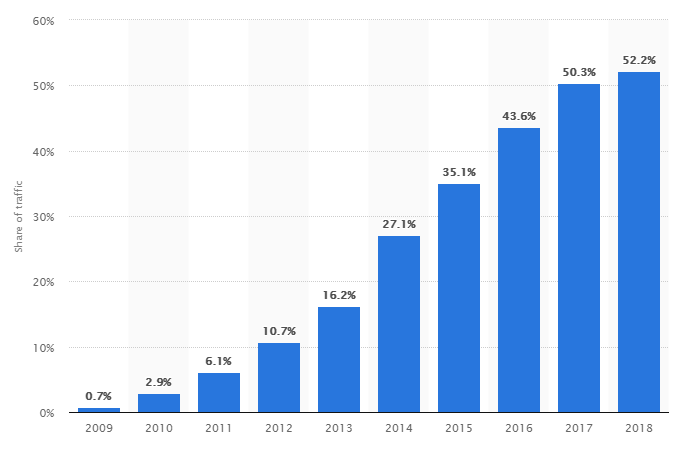
Mobile accounts for half of all global web pages served and we are on an ascending evolution regarding mobile searches. According to Statista, in 2018, 52.2 percent of all website traffic worldwide was generated through mobile phones, up from 50.3 percent in the previous year. Even if the mobile searches have experienced continuous growth, that doesn’t mean the desktop search decreased, but rather more people are using multiples devices to different actions and want to be always informed.
As of February 2017, mobile accounts for 65.1 percent of all web traffic in Asia and for 59.5 percent of all web traffic in Africa.
5.9 Create Google Friendly URLs
Some time ago, we performed an in-depth study on 34k Keywords to study the influence of titles and URLs in SERP. When we analyzed the URLs length to see which is the best format correlated with higher rankings, we saw that the more concise the URLs, the greater the chance to have higher rankings. Below you can see the chart with the extracted data:
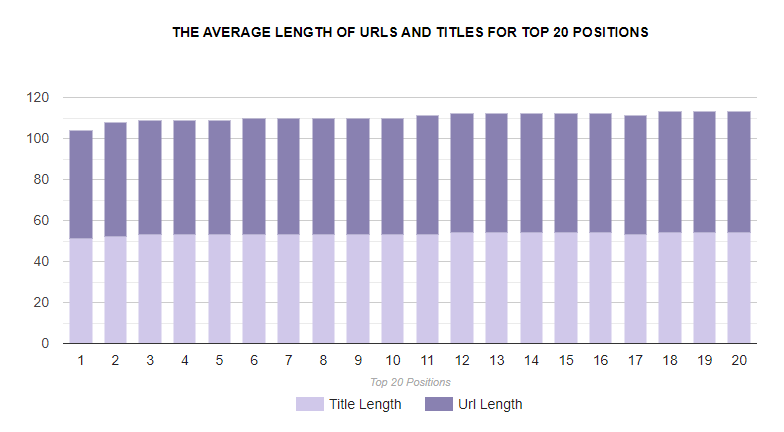
As long as the title length is between 50-60 characters and the URL length is between 90-105, you’re safe. Having a concise URL length carries more benefits than having a long and not so easy to read or remember URL. If the URL and title contain the focus keyword, that is surely an advantage. But we’ll discuss this further on.
Of course, having a concise URL is helpful in all sorts of ways beyond the search results hierarchy. For instance, even if most casual users don’t bother remembering full URLs nowadays, it can still count as an advantage if you make it easy on the brain. Think about EMDs, for instance: instinctively, you are more likely to go with the URL that most resembles your thought process (“I need to find an electrical bicycle…. oh, looks: a site named just that”). The extra effort you can put into it is making sure that not only the homepage, but pretty much any page on your website has its URL fit in a neat number of characters (that, if too large to be easily remembered, can at least be short enough to be easily recognized).
5.10 Spread the Word

Content amplification is a powerful method to reach a wider audience and multiply your links by hundreds. Amplifying your content should be mandatory if you want people to know about it and increase your website traffic.
After you finish writing your article, the process shouldn’t stop. You have to create awareness around it and push it to other people who might be interested. We are not talking about traditional social media marketing or emailing. That’s not amplification. You can look at the amplification process as a way to strengthen the signals of your post.
- Reach new audiences through native advertising;
- Use storytelling to receive a social boost;
- Build a solid community around your brand;
- Use content syndication on Medium or similar websites to build your blog audience;
- Collaborate with influencers to earn links;
- Post on StumbleUpon and absorb targeted traffic;
- Integrate promotion messages or buttons on your webpage.
6. How Important Is It to Update Content on My Website?
Updating existing content is highly important for Google due to its algorithm updates.
It’s 2019 and Google has a lot of Freshness Updates that focuses on providing the user with “fresher, more recent search results”. Google favors fresh content only for some specific queries that deserve freshness, widely known as QDF. QDF stands for Query Deserves Freshness. If a particular search phrase is a QDF, then Google will show up the most recent results.
SEO writing does’t mean just publishing new content, but also updating existing content. Updating a piece of content and adding new information can expand the number of keywords that page is targeting and thus result in more traffic. If you have a longer piece of content, you can try optimizing for multiple keywords and expand your traffic, your audience.
You should always keep your articles up to date. But not just with the date, with the information, the content itself, quality and relevancy!
| The age of a web page or domain isn’t the only freshness factor. Search engines can score regularly updated content for freshness differently from content that doesn’t change. In this case, the amount of change on your web page plays a role. |
 |
CYRUS SHEPARD |
| Owner @ Zyppy / @CyrusShepard |
There are some things that will impact your rankings and they’re closely related to freshness:
- CTR, which is a ranking factor.
- Posting new content frequently might help you expand your search visibility by targeting new keywords.
- The performance of your site’s domain, which is dictated by the number of unique domains that link to your website and by their quality.
7. Should I Delete Underperforming Content from My Site?
Mainly, you could delete content that is performing badly. There are lots of reasons why a piece of content doesn’t perform well. Maybe it is low quality or maybe you’ve applied some black hat strategies for it. Maybe you just tackled a topic that is of no interest for the user or, on the contrary, it is a highly competitive niche and you don’t have that 10x content and therefore, you can’t attract the user.
On the other side, deleting content might be tricky because you don’t know if you’ll ever need that content again or weather it will be relevant at some point. A better option would be to deindex it by adding a rel=“noindex” to those pages. You removed them from SERP, but you can still see them in the admin page. Deindexing is safer and easier. Or you can “noindex, follow” which will tell the robot to noindex, but the user can still access if they know the link through the follow tag.
Before deciding and taking such a drastic measure, you’ll have to perform a content audit, see how your content ranks, see if the information is still valuable and not outdated. We did a major clean-up on the cognitiveSEO blog by following the next content strategy:
- We identified low-performance articles by looking mainly at the ranking position, bounce rate, engagement, search traffic.
- We decided on the content that needs to be pruned: we had to choose if we leave it as it is, redirect or do a quality review (deindex or delete).
- The quality review also included link building for some articles, re-optimization for getting the best content there is for that topic on the web and improving the content performance score.
We even talked with lots of SEO experts that experience content pruning and most of them saw a high increase in organic traffic after they cleaned their website. You can check the case studies and our content pruning story here.
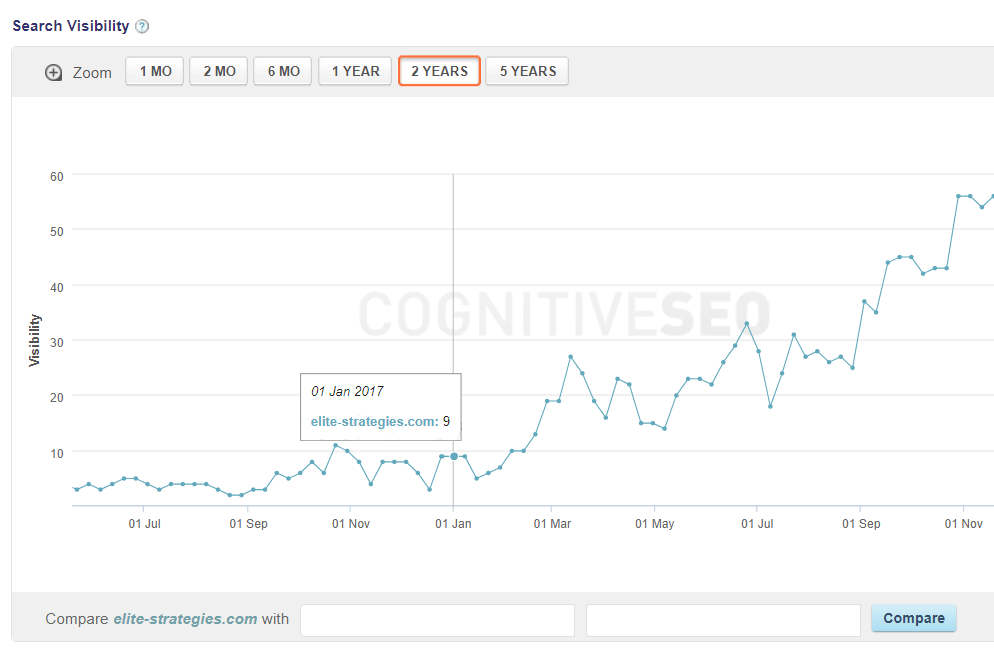
Below you can see the search visibility for the cognitiveSEO website after the content pruning strategy. Of course, meanwhile we kept on writing well optimized articles for both users and search engines, therefore there is not a direct correlation between the growth and content pruning, but most likely, it helped.
There are 3 actions you can take, based on the type of content you have:
- Deindex content that performs poorly and yet serves a purpose to your users. Therefore, it won’t show up in search results, yet users will still be able to access it.
- Delete content that brings no valuable information to the user and is performing badly.
- Redirect the URL if you decide to delete specific pages or repurpose them. It is crucial to redirect the traffic and users to relevant and valuable content, so you don’t have broken pages and lose a lot of links. In this manner, you can repurpose the deleted pages.
To answer the question: Should I delete underperforming content from my site? A better answer would be: repurpose it instead of deleting it. Repurposing content is a highly appreciated white hat strategy. Adding fresh content to make it the best there is, re-optimizing the content for multiple keywords might help your website’s rankings and increase its value.
We’ve compressed our guideline by talking about the crucial elements that cannot miss from your SEO writing process in 2020 and beyond. Keep in mind some of the SEO friendly content pillars like contextuality, mobile-friendliness, HTML tags, evergreen roots, user experience principles, video correlation. Writing for search engine optimization purposes can be difficult and can become a hard-handed job. Yet, you can save any limping piece of content you might have with the strategies explained above. Every well-invested action will bring you results so best of luck in writing high-performing pieces of content.
The post SEO Writing for Copywriters → The Ultimate Guide appeared first on SEO Blog | cognitiveSEO Blog on SEO Tactics & Strategies.
SEO Writing for Copywriters → The Ultimate Guide posted first on
http://nickpontemarketing.tumblr.com/


 Fill your editorial calendar with 5 core content types to help visitors. Also meets content marketing goals with least resource use. With examples & tactics.
 Wonder what Seismic Shift Marketing is and how it will impact your business? Get the Seismic Marketing Shift definition, data and tips to succeed.